|
RONNIE JAMES DIO (Un) Holy Dio "Ronnie was good at producing lyrics and corning up with tunes. I could give him a vague melody and he'd know what I wanted. But after he left things went a bit sour" - Ritchie Blackmore, April 1982. "Ronnie Dio is a better singer than I am. I'm just a good frontman" - Ozzy Osbourne, July 1982. 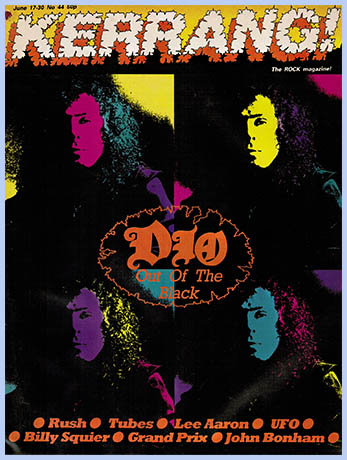 At the risk of incurring a lava flow of mail, let me state right upfront that Ronnie Dio (seventh only in Kerrang's 'male singer' poll for '82) looks, on current form, the most accomplished vocalist on
the heavy rock scene. A provocative claim certainly, but with Coverdale short on strong, class material (see the 'Saints An' Sinners' LP) and Gillan in need of a quick credibility boost (see last issue's
John McCoy feature), the way has been left clear for his pretentious/distinctive grandscale style, a mystical, mind-at-work tack best described as... Dioesque.
At the risk of incurring a lava flow of mail, let me state right upfront that Ronnie Dio (seventh only in Kerrang's 'male singer' poll for '82) looks, on current form, the most accomplished vocalist on
the heavy rock scene. A provocative claim certainly, but with Coverdale short on strong, class material (see the 'Saints An' Sinners' LP) and Gillan in need of a quick credibility boost (see last issue's
John McCoy feature), the way has been left clear for his pretentious/distinctive grandscale style, a mystical, mind-at-work tack best described as... Dioesque.What this means in hard listening terms I'll touch on later; for the moment, suffice it to say that a Dio melody is seldom short of epic, and a Dio lyric rarely concerned with the standard booze/birds/backstage aspects of the rock'n'roll lifestyle. His is a more magnanimous approach - nothing to do with Heavy Metal and its numbskull implications, he insists - reflected over the years in the material he's helped craft. With Rainbow, the likes of Starstruck', 'Kill The King', 'Gates Of Babylon' and, of course, 'Stargazer' (greatest heavy rock number of all time, etc.), and with Sabbath 'Neon Knights', 'Voodoo', 'Children Of The Sea' and 'Heaven And Hell'. Not bad, eh? And there's more to come... to this list of combustibles can now be added such fresh, though soon to be familiar, titles as 'Holy Diver', 'Invisible', 'Rainbow In The Dark' and 'Shame On The Night', the four prime cuts from Dio's new 'Holy Diver' album, the finest of the man's career. Oh dear. I can see early Rainbow fans shaking their heads, copies of 'Rising' held flush with heaving flesh. But I can assure such outraged parties that this particular conclusion was not arrived at lightly, being the end result of many midnight hours of trial and analysis. With a full moon shining overhead and buckets of dry-ice placed strategically around the turntable, the records in question - separated by a seven year span, remember - were spun back to back, my notes informing me that, while 'Rising' proved hard to beat on the 'spinal reaction' front, in terms of production, vocal prowess and unity of purpose, it was 'Dio' all the way. Some pundits felt that the latter opus would simply be a showcase for the wee man's ego, familiar flights of fantasy propped up no more than adequately by hired session hands. But it's plain from the off that what we have here is a genuine band - a group of lively, talented musicians willing to play under the 'Dio' banner yet in no way stifled, subdued or secondary. On drums there's Vinnie Appice, formerly of course with Sabbath, on bass/occasional keyboards Jimmy Bain, an old Rainbow pal of Ronnie's last seen with Wild Horses, Phil Lynott and The Scorpions, and on guitar Vivian Campbell, a 21 year old from Belfast, confident in his own ability and determined to keep a goodly distance from all combos suffering the plague-like scourge of (Eddie Van) Halitosis. 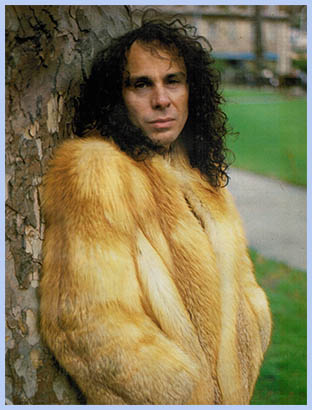 Ronnie's clearly the man in charge - he produced the album, assisted by former Sabbath engineer Angelo Arcuri, wrote all the lyrics and melodies and, along with wife/manager Wendy, picks up the bills - but each member has a vital, vested interest in the project's success and is consulted accordingly.
Indeed, were weakness to be found in the musical foundations supplied by Dio the band, Dio the man might as well not bother. But, as it is, Messrs. Appice, Bain and Campbell prove eminently compatible, combining to bring out the imagery inherent in the lyrics and produce an essentially British-sounding release. Fusing the more riotous aspects of early Rainbow ('Stand Up And Shout') with the measured, 'size twelve' stomping of latter day Sabbath ('Holy Diver'), each of the nine tracks is a mini-drama, a masterstroke of melody and might, packed to perfection with rhythm section poke and lustily smote powerchords left to die a distant, natural death. Along with ZZ Top's 'Eliminator', one of the best rock albums released so far this year... To this point, you'll note, I've made precious little mention of Sabbath. An intentional move. After all, Ronnie's initial response to the 'little Hitler' accusations of Iommi/Butler, accusations that labelled him the sort who dons jackboots and 'tache to order an extra pinta from the milkman, was detailed in an earlier issue. Besides which, I reckon most fair-minded Sabs fans are heartily sick of the claims and counter-claims put forward by the fractured parties in this particular bust-up. In fairness, though, it wasn't Dio who cast the first fighting pebble, so best to allow him one further blast, then press on... "I never tried to take over Black Sabbath", he says in record-straightening tones. "I never felt that it was my band. It's just that where you have weak characters the strong are always gonna surface. I mean, I never really heard Geezer (Butler) make any decision other than to have another pint!" Ronnie, ably supported morally by both Bain and Campbell, sips something white and German and, oblivious to the efforts of a West End wine bar waitress to dislodge us from our accommodating corner, firmly denies withholding material from Sabbath or pursuing his solo project while 'Live Evil' was still being mixed. "To me," he says, Bain nodding in agreement, "the whole situation smacks of a group of unintelligent people who got together and decided they had to make up a story to cover themselves." Originally, Ronnie's intention had been to record a solo album from within the Sabbath ranks, and plans were at one stage laid for Vinnie Appice and brother Carmine to hammer away in unison on a particular track. But, once separate from BS, he decided it was time to piece together a bona fide band. To this end, he and Vinnie set to work in Los Angeles, bringing in guitarist Jake E. Lee (then with locally based Rough Cut) for a short while before transferring operations to London to find the British musicians the singer particularly wanted. 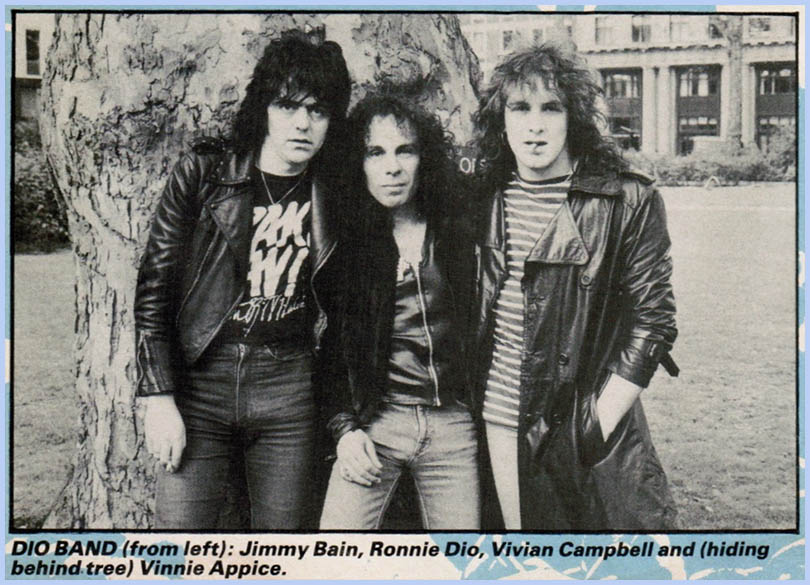 Having sustained a friendship with Bain since Rainbow days (the two jammed together at the Lyceum when Jimmy was in Wild Horses), Ronnie called him up straight away and found, to his luck, that the itinerant bassist had just finished touring with Phil Lynott. That link renewed, Bain set off in search of a suitable guitarist, the final element... "I was in Dublin rehearsing with Phil and I was looking for Viv but I couldn't find him. So I asked the engineer at the studio we were in and he said: 'he'll be here tomorrow afternoon' - that's how I found him. I got him to give me a tape and a couple of days later when I met Ronnie I played it to him. We rang Viv at five in the morning, then got together for a blow." This hastily organised jam took a large bite out of the early hours, by which time it was clear a new alliance had been forged ("if it's magic, it doesn't take long to tell" - Jimmy Bain). Viv, understandably nervous at playing in such celebrated company and feeling there was no chance he'd land the job anyway, simply relaxed and let rip. Dio had found his man... "His chord playing was the thing," he recalls. "Americans seem to be very fiddly, they don't play big, rousing powerchords and have great fields of accent, but Viv has that because he's a British player brought up in that tradition. And as for his solos... as far as I'm concerned, they should put him in the ranks of soon-to-be Guitar Heroes because I think they're brilliant!" With personnel picked, it was time to rehearse and get something down on vinyl. Initially, Ronnie toyed with the idea of recording at the Record Plant in the heart of LA but, put off somewhat by the Hollywood hangers-on that pass through its portals, booked time instead at the more out of the way Sound City, a studio used by such AOR legends as Tom Petty, Fleetwood Mac, Quarterflash and Rick Springfield. Including rehearsal periods and the time it took Ted Nugent (an unexpected visitor) to finish his opening sentence, the album came together in about four months, with Dio taking customary care over his lyrics, sadly not reproduced on the inner sleeve. To some, of course, it's all just aimless waffle, a barrel-load of bullshit designed to baffle rather than enlighten, but those prepared to take their imagination for a run should find something on offer within Dio's blatantly escapist, rose-tinged philosophy. 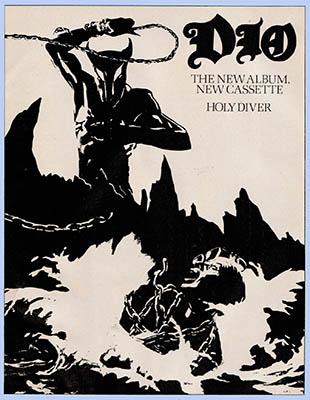 "My lyrics usually have a lot of different meanings," he explains. "Whoever listens to them can believe whatever they want. Why should I shove something down someone's throat? I tend to write in romantic terms relating to medieval times - King Arthur, knights and all that kind of thing.
Even though they didn't have toilets then, it was still a wonderful, imaginative age when chivalry was rampant and all the ladies beautiful. They probably had shit running down their legs but you couldn't see it under the marvellous gowns. "I don't consider myself a poet or anything, mind. I'm not Bob Dylan, Billy Shakespeare, Shelley or Keats, but I do like lyrics that show you've worked at something." Sensitive of soul and lofty of spirit, with a palate for good wine and a pocket for fine art (he's currently proud owner of two paintings by Dali. Price? Don't ask!), Dio likes to temper his brand of mayhem with some cerebral activity, an interesting blend that, despite the attentions of the excellent ZZ Top, might well steal the show - PA/weather permitting - at this year's Donington mud-spree. Certainly, no band there will have a stronger repertoire to draw from as, in view of the background of present personnel, he plans to spice his set of freshly-penned originals with a selection of tunes from his name-making Rainbow/Sabbath days. 'Man On The Silver Mountain' will definitely feature, 'Starstruck' is a possible and 'Stargazer', or snatches of it at least, a very strong probable. While from his later Black period it looks likely that 'Neon Knights', 'Children Of The Sea' and 'Heaven And Hell', in part, will make their presence felt. And (yipee!) there won't be any extended solos to endure. "The version of 'Heaven And Hell' on the 'Live Evil' album is a great thing to go to sleep to as far as I'm concerned," says Ronnie. "It's just too long and very, very self-indulgent." At the moment, Castle Donington is the only confirmed gig for the band, based to all intents and purposes in LA. But Dio hopes to precede this appearance with a few warm-up dates and follow it with a full-blown European tour, hitting the UK in September and including visits to Germany, N. Italy, France, Holland, Scandinavia and probably Ireland, where the plan would be to play both Dublin and Belfast. There might even be a one-off showing at the Marquee before the year is out, but all of this depends to a large extent on whether the album cuts daisies or shoots for the stars. My money, as if you need to be told, is on the ascendant option, and I've similarly high hopes for the next LP which, according to Dio, will probably go in "stranger directions, perhaps more in line with early Rainbow, because that's really the kind of texture I like most." Blackmore, the anger of his first post-Purple days long evaporated, won't follow that path any more. Dio clearly will. I wonder (he asks rhetorically) who'll get the most support... "Long live rock and roll" - Ronnie Dio, 1978. © Dante Bonutto, Kerrang no 44 - June 1983  |