|
Ritchie Blackmore Legend of the Rock Guitar 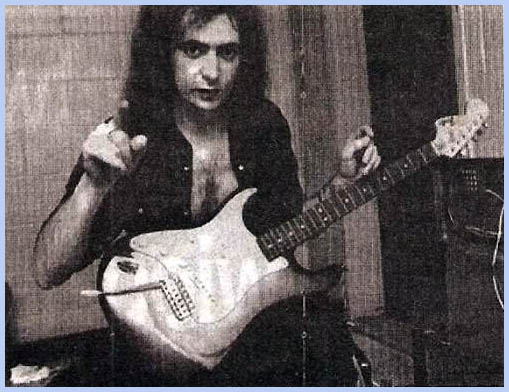 His ignorance of the press and critics provokes some, while his talent amazes others. His reputation is one of the most incredible, and his artistic achievements are in no way inferior to today's popular rock hits. Whatever one might write on paper, however, will not be commensurate with his actual creative abilities, just as even Beethoven's Ninth Symphony appears on paper as a collection of black lines and dots. Ritchie Blackmore is a classic case of a rebellious individualist who shuns people. As one of the pioneers of strictly heavy-rock guitar, he gained his popularity playing with the British hard-rock band Deep Purple, and after its breakup, he created his own ephemera, a group called Rainbow. The first decade of the seventies certainly belonged to the period of his greatest glory. Blackmore's musical searches and fascinations contributed to the creation of DP's greatest hits, and songs like "Child in Time," "Highway Star," and "Smoke on the Water" were at the top of many charts at the time, with their concerts attracting tens, and even hundreds, of thousands of listeners worldwide. The musical output of this artist served as an inspiration for many younger heavy metal groups formed later. The breakups of famous rock formations, and the subsequent creation of new so-called rock supergroups based on their members, constitute one of the characteristic elements of rock show business. This is how Ritchie Blackmore's Rainbow was born, the most prolific and popular of the formations originating from Deep Purple. Blackmore, as the bedrock of the band, now gives vent to his musical interests, which were suppressed during his collaboration with his colleagues in Deep Purple. Blackmore's fascinations with medieval music, Far Eastern melodies, and classical music are reflected as a colorful backdrop in Rainbow's songs. Hendrix-esque sound solutions, skillfully adapted to his own interpretations, along with the aforementioned interests, form the basis of this musician's unique style. Incredible freshness and spontaneity are inseparable elements of the Rainbow sound. Their live performances were a kind of spectacle played out on a specially designed stage. A medieval castle in the background, a monumental color-changing rainbow above the stage, and the leader's stage antics—such as setting the stage on fire or smashing guitars and throwing them into the audience—added incredible spice to the whole phenomenon. There are few artists who sound equally good on studio albums as they do live. Classic live performances of hits like "Man On The Silver Mountain" or "Catch The Rainbow" prove that Ritchie certainly belongs to them. The period of this musician's greatest glory is certainly behind him, yet like most bands from the seventies, he is experiencing a renaissance of his popularity in Eastern European countries, which of course includes Poland. Without much advertising, the artist filled multi-thousand-seat concert halls in Poland several times while performing there with the band Deep Purple. Blackmore speaks with great enthusiasm about the Polish audience and, together with his new incarnation of Rainbow, is striving for performances in our homeland. His latest album achieved much greater popularity in Poland than in America. However, the band's recent European tour did not include the country on the Vistula River. It is difficult to determine why right now, as both the artist and the Polish promoter are very interested in each other. Meanwhile, local listeners had the opportunity to see and hear Blackmore during the group's only Canadian performance at the Toronto club Warehouse. On the night of February 26, 1997, despite a lack of advertising from both the record label and the local promoter, Ritchie Blackmore attracted a sizable crowd of his enthusiasts. Alongside tried-and-true concert material, the band presented tracks from their new album. Despite the club's poor acoustic conditions, new songs such as "Ariel" and "Wolf To The Moon" warmed up the gathered audience. Despite the small scale of the event for an artist of his stature, one could feel and hear 24-karat Rainbow. Truly good prospects, passionate music, old memories at their finest. The most important thing is not to lose one's own legend, which Blackmore certainly cannot be accused of, as an aura of mystery still surrounds him, and he effectively defends himself against the nosiness of the media and his admirers. Nevertheless, a few weeks after the Toronto performance, I managed to track Ritchie down in the USA. Sentiment toward the Polish audience and warm memories from his performances in Poland with "Deep Purple" must have worked, as I managed to persuade the artist to give a few modest statements especially for Polish fans in Toronto: Do you remember the last time you performed in Toronto? RB: Probably in 1985, I'm not sure. Why did you leave Deep Purple after the European leg of the tour ended in 1993? RB: I didn't want to remain stuck in an armchair for the rest of my life. How did you recruit your new Rainbow lineup? RB: I gathered information by word of mouth; someone told me that these specific musicians were good. Are you satisfied with the new musicians? RB: I am never satisfied, especially with myself. What inspired you when you were creating your latest album? RB: Freedom, liberty inspired me. What was the role of vocalist Candice Night? RB: Writing lyrics, composing, and well, she is my fiancée. You have already performed in Poland with Deep Purple. How do you remember Polish fans? RB: Wonderfully. Will the audience in Poland be able to see you there with Rainbow? RB: Yes. We have been asking for this for two years. I heard you are working on a new solo project. What will it be? RB: The album is called "Shadow Of The Moon"; it reflects medieval melodies and gypsy dances. Renaissance fascinations. What is your opinion on the current alternative trend in rock? Do you think it is already coming to an end? RB: Everything has its beginning and end, depending on where you are and what it refers to... All that remains is for us to wait for the next musical incarnation of Ritchie Blackmore, who perhaps this time will find the legendary treasure located on the other side of the rainbow. © Krzysztof Wierzbinski, Gazeta Magazyn - May 9, 1997  |