|
Rainbow A Storm of Power 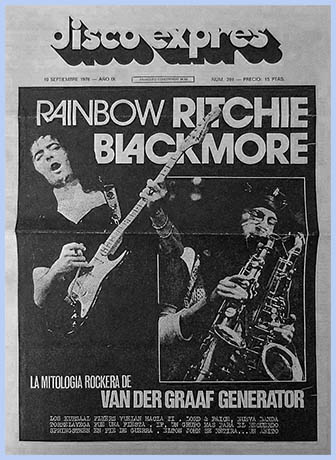 A warning to Deep Purple fans: do not mourn the death of your band, for a new piece of wax has been born that will drive you back to the madness of yesteryear. You will be happily shaking your body and "playing" guitar to the beat of the beloved Ritchie—now nicknamed "the savior"—since with his Rainbow he has brought power back to our minds. Uggg! Ladies and Gentlemen: Rainbow RISING. And bravo!
The departure of the great Ritchie Blackmore from Deep Purple wreaked havoc on the band. These were the reasons shared by the man himself: "Why did I leave Deep Purple? I felt the allure of creating new songs, of doing something new, and that's why I formed Rainbow. It's also why Rainbow will never play a Deep Purple song. People who come to see us think they will hear 'Smoke on the Water,' but they are mistaken. One of the reasons that motivated my departure from Deep Purple was exactly this — doing things from my previous band would be too easy and uninteresting. I also decided to leave Deep Purple because, after the departure of Ian Gillan and Roger Glover, the band went through a major crisis from which they will hardly escape, even though my replacement, Tommy Bolin, is a great guitarist." Ahem! I would say that while the second reason seems very valid, leaving Deep Purple on the grounds of creating new music seems a bit much, considering Rainbow sounds exactly like Deep Purple. If you don't believe me, listen to "Rising." THE HISTORY OF THE RAINBOW Once upon a time, there was a band called Elf. Their greatest achievements were a series of concerts opening for Deep Purple and an album produced by Roger Glover. Elf featured the following names: Ronnie James Dio on vocals, Gary Driscoll beating the drums, Craig Gruber on bass, and Mickey Lee Soule handling the keyboards. Ronnie and Ritchie Blackmore became great friends, talked about future projects, and decided to meet up again. Ritchie came to this new meeting with a "brilliant" idea: to form a band with all the members of Elf, which would be named Ritchie Blackmore's Rainbow. Ritchie left the band called Deep Purple, and his new group was born, signing with a new label, Oyster—and here we are. The band's first album was highly reminiscent of Deep Purple's music, although Ritchie’s personal ideas could be heard on a few tracks. The group began their first tour on Yankee soil, specifically in New York at the Beacon Theatre, and their show was complemented by a massive lighting rig, smoke everywhere, strobe effects, and a giant rainbow spanning the entire length of the stage. Deep Purple couldn't have done it better. The band performed all the tracks from their album along with two extended extra numbers. The best part, however, was the wild "Man on the Silver Mountain." The big surprise of that concert was that the live band had very little to do with the one that recorded the album. Ritchie had fired all the members except his beloved Ronnie. The newly recruited members were Cozy Powell on drums, who has played with Donovan, Tony Joe White and Mickie Most, as well as with the Jeff Beck Group on the LP Rough and Ready. Later on, he released three commercial pop singles: "Na Na Na," "Dance With the Devil," and "The Man in Black," which brought him a lot of success and money. Tired of this music, he decided to form a good rock group alongside Clem Clempson and Greg Ridley, who had been left on their own following the split of Humble Pie. The group was supposed to be called Strange Brew, but they couldn't reach any agreement. During a seance, he crossed paths with his old acquaintance Ritchie Blackmore, who invited him to take the spot left by the unfortunate Gary Driscoll, which he quickly accepted. Jimmy Bain is the new bassist; he played with John Lee Hooker and later on with a band called Harlot. And finally, Tony Carey, who does his best on keyboards. He is a Californian studio musician with an incredible Native American look, who was found by chance by Blackmore. They say Ritchie was delighted by the young man's dedication to work. With these members, Rainbow has launched themselves forward, played their gigs, and recorded a new album: Rising. RISING AND WHAT IS TO COME 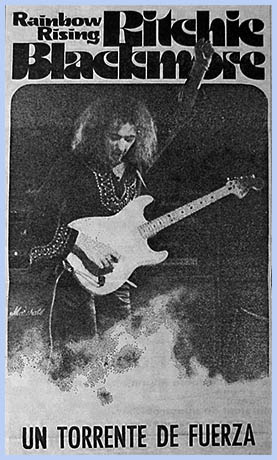 The new album was recorded in February of this year and features six tracks—four on the first side and two on the second.
The first track is "Tarot Woman." The intro is synth-driven, which might make you suspicious of an electronic mess, but no! Ritchie's guitar is right there, and Ronnie is shouting a "You, You, Youuuu!" A frantic rhythm and the memory of David Coverdale and Deep Purple will pop into your head — a track to drive you crazy with its power and internal chaos. On first listen, you might complain about the whole band except Ritchie; it's not exceptionally brilliant. The second track is "Run With The Wolf," where Ritchie delivers heavy guitar strikes while Ronnie is backed by some unexpected backing vocals. Another track that is a bit weak but powerful. The third track is pure madness, as is the fourth. Two irresistible openings — beautiful, man! — to go crazy, grab your girl, and throw her in the air while screaming "Dance, little dance." Ritchie delivers a joyful solo on the first one, "Starstruck," while Cozy Powell drums like a man possessed on the final cut of this first side. Side two features two tracks, the highlights of their live shows, although here they don't have the duration of the live versions—going from half an hour down to eight minutes. Still, we get something as great as Cozy's drum solo backed by Tchaikovsky. The album credits mention backing by — attention! — the Munich Philharmonic Orchestra, but they are nowhere to be found! I looked into it and found out that a very brief solo on the first track, "Stargazer," which sounded like synthesizers, was actually done by a bunch of violins, apparently because the poor keyboard player is so hopeless he doesn't even know how to play the synthesizer. Frankly, it sounds like a sham to me. There is no orchestra here, no matter what they claim. The beginning of "Stargazer" is drum - led while Ritchie distorts his guitar; it's another very heavy track but lacks much appeal. The final track is "A Light in the Black," which features part of Cozy's drum solo, followed by a chillingly good solo by Blackmore, and then a dreadful synthesizer solo that fortunately doesn't last long. Another irresistible track that closes the album, the energy, and the end of the comparisons with Deep Purple. Because, I repeat, the band sounds way too much like Deep Purple to think of it as a different style of music. Overall, and to cut to the chase, this is a great album that will drive lovers of high-energy, heavy, heavy, heavy rock absolutely wild. © Jordi Tarda, Disco Expres (Spain) — September 10, 1976  |