|
Rainbow Japan Tour 1995 November 11 - Yoyogi Olympic Pool, Tokyo 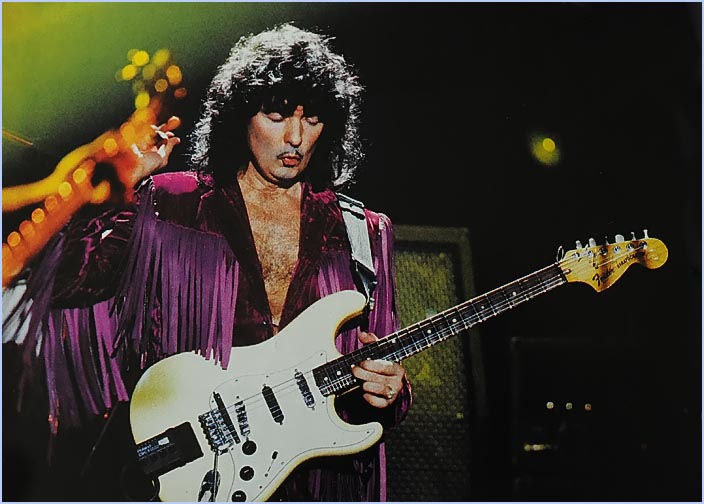 Following the tragic collapse of the Deep Purple myth, what did we witness on the other side of the reborn Rainbow's brilliance, resurrected to offer grand dreams and hope...? RAINBOW, which closed the curtains on its history with its 1984 Japanese tour, has been resurrected after an 11-year absence, finally bringing their live show back to Japan. Quite a few fans were highly skeptical of a "complete revival" from Ritchie, adopting a "seeing is believing" attitude. However, now that the Japanese tour has concluded, everyone must be deeply immersed in the profound emotion of realizing, "The real Ritchie has truly returned." When discussing the live performance of this incarnation of RAINBOW, the biggest talking point is undoubtedly the fact that Ritchie Blackmore —who had seemed completely lackluster during his final days with DEEP PURPLE— has entirely recaptured his classic vitality as a player. Regarding the Joe Lynn Turner era of DEEP PURPLE, opinions varied depending on the night, with some saying "he played reasonably well" and others countering that "he lacked his old spark." However, by the time Ian Gillan replaced Joe and returned to DEEP PURPLE, it became undeniably apparent to everyone that "the legendary Ritchie of yesteryear is gone..." Yet, watching Ritchie play so vibrantly at the helm of this new RAINBOW —complete with his signature showmanship— he is the absolute spitting image of his classic RAINBOW persona. To be perfectly precise, his performance has toned down slightly, but taking his age into consideration, it is still a thoroughly "dynamic performance." At the very least, his visible determination to play with everything he has was enough to bring tears to the eyes of long-time fans. The most glaring contrast to the RAINBOW of the past is that this iteration completely projects the image of being "unmistakably Ritchie's band" above all else. In the past, whether it was Ronnie James Dio, Graham Bonnet, or Joe Lynn Turner, you always felt a fiercely dominant ego in their stage presence that declared, "I'm the singer, so I'm the star of this band!" However, the current singer... The singer, Doogie White, yields the center-stage spot to Ritchie during guitar solos, moving over to sing from the far right side of the stage during the second and third choruses. Of course, there is nothing inherently wrong with that positioning, and he certainly injects plenty of energetic showmanship to rile up the crowd, but it leaves a powerful impression that he is strictly playing a "supporting" rather than "leading" role. In terms of dynamic, it almost carried the distinct flavor of a "singer in Yngwie Malmsteen's band." I don't mean this as a criticism by any means; rather, it demonstrates his clear understanding that this tour is all about showcasing Ritchie's return with RAINBOW, and I feel it perfectly symbolizes the welcoming, amicable atmosphere surrounding the current lineup. With Doogie leading the charge, the show made it glaringly obvious that every single member holds immense reverence for Ritchie — and that was the defining characteristic of this RAINBOW tour. In the past, the only time a RAINBOW lineup was completely primed to support and react to whatever whim Ritchie chose to play on stage was during the era when Joe Lynn Turner, David Rosenthal, and Chuck Burgi were all together. Yet back then, unlike now, it would have been unthinkable to include this many DEEP PURPLE tracks in the setlist. The current incarnation of RAINBOW, at least on this particular tour, exists fundamentally to allow Ritchie Blackmore to do whatever he wants to do, and one can comfortably say they have assembled an incredibly competent group of musicians to fulfill that function perfectly. While Doogie White's vocal range may not be quite as expansive as Ronnie's or Graham's, he can cover higher registers better than Joe. Meanwhile, bassist Greg Smith handles a role akin to an "unobtrusive Glenn Hughes," allowing them to execute "Burn" successfully, and his beautiful vocal harmonies on "Temple Of The King" significantly amplified the track's charm. It was also a treat to hear "Smoke On The Water" performed in its Mark III DEEP PURPLE arrangement. On the second night at Yoyogi in Tokyo, while Ritchie was delayed dealing with guitar technical difficulties, Doogie kept the momentum going by improvising an acapella rendition of "Rainbow Eyes" — a moment that beautifully captured the band's inherent flexibility. Furthermore, starting from that very day, the setlist was tailored for the Japanese audience by incorporating classics like "Street Of Dreams" and "Stone Cold." They even went so far as to revive the time - honored "tradition" of performing "Maybe Next Time" when returning for the encore, showcasing an incredibly thoughtful level of consideration. Throwing in an unexpected cover of Nazareth's "Love Hurts" is also an element unique to the chemistry of this specific lineup. It was an excellent call to overhaul the set structure for the latter half of the tour dates, breaking away from the previous European leg's routine where the encores consisted almost entirely of DEEP PURPLE numbers. Additionally, the moments where backing vocalist Candice Night (Ritchie's fiancée) was introduced on stage right after "Ariel" were captured in several locations. This sort of heartwarming moment would have been utterly unimaginable during the Ronnie-era of RAINBOW or in DEEP PURPLE, serving as a clear reflection of how much Ritchie has "mellowed out" these days. (Introducing Candice is entirely justified given her official capacity as a backing vocalist, so it shouldn't be lumped into the same category as Yngwie introducing Amber.) Because Doogie White was specifically chosen to match the musical direction Ritchie currently wants to pursue, the fact that his vocal timbre can come across as a bit too soft in a live setting remains a very minor drawback. There may be voices among the crowd complaining that there aren't enough songs from the Graham era, or demanding more material from the Ronnie era, but as is explicitly clear from the interview, the overarching concept of this show is "Ritchie playing what he wants to play," so it is perfectly fine as it is. Personally, I am usually the type of fan who wishes they would play "more RAINBOW and less DEEP PURPLE!", but if we view this as Ritchie finally venting the frustrations and restrictions he faced during his final days with DEEP PURPLE, we really have no right to complain. That being said, I wasn't entirely thrilled with their decision to replace their long-standing opening track, "Spotlight Kid," at the final Yokohama and Bay NK shows, opting to burst out of the gate with "Too Late For Tears" instead... I also can't help but feel that "All Night Long" could have fit into this particular set structure effortlessly... but perhaps giving in to these kinds of greedy complaints is simply the tragic nature of being a die-hard fan. In terms of show pacing, one element that stood out as slightly problematic was the excessively drawn-out ending of "Ariel." I imagine there were quite a few audience members who found themselves getting a bit bored during that stretch. Granted, the song also features a lengthy clean-tone intro solo from Ritchie, but that represents the classic, unchanged "Ritchie in a live environment" that we know and love; modern, impatient youngsters aside, I thoroughly enjoyed it. However, the guitar solo section at the end of "Black Masquerade," which takes the form of a call-and-response with the keyboards, felt overly extended—almost as if Ritchie had run out of ideas and was struggling to figure out what to do with it. Given how inherently dramatic that song is, it felt like a bit of a missed opportunity. Greg's vocals did a wonderful job of bringing out the charm in each track from Stranger in Us All, and including his previously mentioned contributions to "Temple Of The King," he is doing stellar work. Paul Morris was also far more prominent in a live setting than on the studio album, and while his classical flourishes during his solos were creative and well-executed, you get the impression he still has more potential to unleash. Chuck Burgi was absolutely beyond reproach. Returning with an even more aggressive edge than in his earlier days, he proved exactly why he is trusted as the go-to utility man for Blue Öyster Cult. His extended, improvisational call-and-response duals with Ritchie during the introductions to "Difficult To Cure" and "Man On The Silver Mountain" were highly entertaining. One element that has drawn a lot of chatter is Doogie's "Bruce Dickinson-style stage mannerisms." To be perfectly honest, it does look rather tacky, and certain purists were likely irritated, thinking, "This isn't Iron Maiden..." It would be best if he kept that stuff to a minimum. Another point that will likely divide opinion is his non-stop barrage of Scottish folk songs (and their parodies). Utilizing it a couple of times as a substitute for standard stage banter is highly entertaining, but repeating the exact same routine predictably every single night causes the joke to wear thin. The repertoire seems surprisingly limited as well... it might be wise for him to rethink that approach. That being said, his actual vocal delivery when singing those traditional folk melodies and "Rainbow Eyes" is genuinely magnificent, and I completely understand his desire to play to his strengths. For better or worse, it's almost as if he is explicitly demonstrating that he is a singer "unsuited for Iron Maiden." Ultimately, whatever flaws one might find, there is no denying that he possesses a spectacular voice. If he can just iron out his stage movements and the parody songs, he should be more than capable of living up to our expectations as the frontman of RAINBOW for a long time to come. This RAINBOW tour was remarkable for featuring a genuinely different setlist almost every single night; it is rare to encounter a band operating with this degree of flexibility. I want to offer my unstinting praise to each individual member who made that possible, while simultaneously extending my deepest, heartfelt gratitude to the great Ritchie Blackmore for displaying such immense motivation on this run. Looking ahead, I truly hope that a grand and bright future lies just beyond the sky spanned by this beautiful, reborn Rainbow... © Kaz Hirose, Burrn Magazine no 2 - February 1996  |