|
Roger Glover I've Never Taken My Bass Playing Seriously  Roger Glover of Rainbow is a man with a long history in the music biz. There are few heavy rock bassists around today who can either match his experience or indeed his talents. If there is a bass player around who can be called a 'virtuoso' then this is the man.
Like most people who end up on the bass, it didn't happen by some grand design. "My first instrument was actually a folk guitar, on which I could play E, A, D and a kind of G. I can't say I was great at it. Anyway, when rock 'n' roll got a hold of me through the skiffle movement of the late fifties, I was in a school band and as there were two other guys in it with more guitar talent than myself I moved onto bass. I thought it would be the easiest instrument to play. Now, that's a point I'd like to make at the outset. Bass guitars are easy to play INITIALLY. They are also the most difficult to perform on with any degree of individuality—that's why bassists tend to be so anonymous. Mind you, in a hard rock terms that's no bad thing. There's no room for the likes of Jaco Pastorius in an HM band and that's good for someone like me, I'm no flashy player." Glover's first bass model was—a Spanish guitar! "I took off a couple of strings and put on a pick-up." From there, he moved onto a Hofner. "It was basically a Fender copy." In terms of amplification, he was forced into borrowing such as he could from any source available. "I remember on one occasion, Bert Weedon came down to see us play as his son was in the band. For that gig, we had one amp, a Vox 15, through which all the instruments and microphones went. It sounded terrible. But the upshot was that the man himself lent me his personal Selmer model. So, there I was on-stage with an amp engraved with the name 'Bert Weedon'—that was a great thrill. Eventually, to save on cost, I used to nip down to my local hi-fi store and buy a couple of Goodwin speakers for about £5 and then build my own cabinet. Mind you, I probably learnt more about carpentry than anything else. But it did allow me to experiment with various ideas and I continued to use self-constructed cabinets right up until I joined Deep Purple. I still believe that for a bassist the hardest problem to overcome is that of getting a good cabinet. When I first started, they were not built or designed for use with a bass and these days this still continues, although people are beginning to make them better." Back on the instrument trail, Glover's first, as he termed it, "real guitar" was a Fender Precision. "When I wasn't playing, I'd stand this in a corner and just watch it for hours. I was so proud of it." These days, the man, being the successful star he deservedly is, has a variety of models on hand. "On the recent Rainbow album, 'Straight Between The Eyes', I've employed a Hondo Longhorn, which is a really cheap Japanese job that gives a wonderful sound. But it doesn't give enough of a gutsy feel on stage. So I prefer to stick to a Gibson Thunderbird or Ovation. I've also invested recently in a new Fender Precision, complete with up-to-date electronics." But on the strings front, Glover has little preference. "No-one has come forward to sponsor me yet. So I go along with whatever my roadie gets me. One thing I will say about strings is that I'm not one of these people who likes to change 'em every week or so as a matter of routine. I prefer to work strings in and get a proper feel for 'em. In fact, to be honest I do find it difficult talking about anything on the technical side of bass playing because I don't REALLY take it at all seriously. That may sound a bit strange but to me it's FUN. The serious side of my musical life lies in writing and producing." 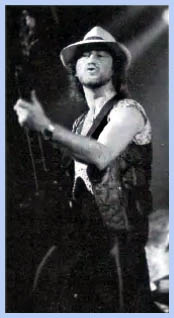 All of which means that when it comes to giving out advice to aspiring bassist, Glover rather shies away. "I don't think there is much I can say to 'em—it's all down to experience and learning from your mistakes. It's a bit like trying to tell a child not to go too near a fire as they'll get burnt—most kids won't listen to you anyway and consequently have to find out the hard way. To me any musical instrument is an extension of someone's personality and everyone will therefore play it differently.
One thing I will say is that regardless of whether or not you are a natural musician, a basic grounding in the traditional western musical form is important, you know the '12 bars'. I was rather lucky in that I had piano lessons for a year when I was seven and hence didn't have to learn to simple chord structures from scratch." "To me, though, there is something which in it's own right is equally as important as technique and application: never get carried away by your own talents. It's the easiest thing in the world for someone on-stage to imagine that the fans are cheering them personally. They're not—it's the BAND which gets the applause. All too often I've seen musicians fool themselves into believing that they are far bigger that is really the case. So when they've eventually allowed their egos to dictate that a solo career is worth pursuing, they inevitably come a cropper. Fame, like drugs and alcohol, exposes weaknesses in a person's character. If you allow it, stardom WILL turn your head. Always keep your feet firmly on the ground and as I said earlier DON'T TAKE IT TOO SERIOUSLY. One thing that always embarrass me is when fans come up and tell me I'm the greatest bassist around. When a musician starts to believe all of that, then it's problem time!" Sadly, Rainbow fans won't be able to lavish praise on the modest bassman for some time to come, as the band have no UK tour plans for '82. However, the man has found time to pen a booklet of explanatory notes on his musical approach. Available at the present time only in Japan, this publication reproduces six of the most famous Purple/Rainbow songs associated with Glover, alongside which he's provided an insight into why certain rhythm lines were used in specific places. This nicely complements all Glover has said above and is undoubtedly an essential purchase for would-be bassists. © Metal Mania Magazine no 5 - 1982  |