|
RONNIE JAMES DIO Dutch Courage Geoff Barton Travels To Holland And Finds Dio In The Pink 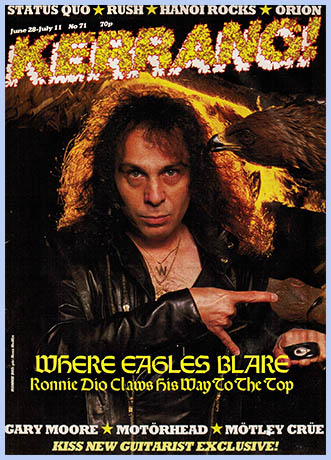 YAY! YAY! Wilcom! Wilcom! Und now das is der Heavy Metal Bimbo - DIO!"
I'll be damned if I know what a 'Heavy Metal Bimbo' is, but that rap is coming from the cake 'ole of a manic Dutchman standing up there onstage bellowing away in his native language - and he seems to know exactly what he's talking about. So do the crowd down on ground level, who respond to this ridiculous introduction with the restraint of a pack of rabid Dobermans on the heels of an escaped POW. Taking up the somewhat unpredictable chant of "Dio! Dio! Dio!", these kamikaze clogwearers suddenly hurl themselves forward in order to catch a glimpse of their idol. Security springs into action, Netherlander muscle men calmly approaching the tall, tough steel fence and sending climbing transgressors hurtling back into the seething throng with a firm shove and a malicious smile on the lips. It's like being at some overpopulated, demented human zoo, I reflect as I turn to look at the slavering Hollandic horde penned in behind me. Eyes glazed and glinting with feverish fury, mouths wide open and spraying spittle, these tulip-growing gonzos are behaving like animals plucked straight from the wild to spend their first night behind the bars of a cage. I've got to admit, I'm more than a little frightened; given a choice, at this precise moment I'd much rather be at Chessington ogling the p-p-p-penguins! But no - instead I'm here in Flat Land to attend the Pink Pop Festival with the specific intention of checkin' out and talkin' to Ronnie James and his disciples. The Dutch have been holding this outdoor event for years now and they really have got the whole thing down to a fine art. In comparison to the chaos of Poperinge, this flesh-toned spectacular is an organisational dream - twin Reading-style stages, near perfect sound, barely 15 minutes between acts, some of the best backstage facilities known to mankind and NO MUD combine to make life pretty comfortable for press and public alike, bestial barricade-breakin' bozos behind me notwithstanding. The bill, I'm not so sure about. 'Dance Hall Days' dullards Wang Chung opened the proceedings around 11 am, to be followed by Marillion, John Hiatt, the Pretenders and then Dio. Later in the day the show is due to be rounded off by Billy Bragg, Big Country and finally headlining reggae artist Jimmy Cliff. A weird selection, eh chums? But the frying Dutchmen (it's a beautifully hot and sunny day) out front seem perfectly content and open-minded enough to accept this musical melange. That said, however, the reception garnered by Chrissie Hynde's crew, Dio's direct predecessors, was as nothing compared to the wild scenes currently goin on about me. Dio's definitely the success of the fest so far, and it's not difficult to see why. Beginning with 'Stand Up And Shout', roaring musical expertise and Ronnie's amiable-but-awesome persona make for a killer concoction: quietly, calmly, with little fuss but expert timing, this lot have crept up the loudness lot have crept up the loudness ladder to become what we in the trade term 'a major band'. Decked out as usual in the height of sartorial elegance (moth-eaten T-shirt emblazoned with chintzy sequinned cross, tattered remains of kitchen mop tied around waist, interesting selection of colourful handkerchiefs attached to ankles) the diminutive Ronald Padavona takes command from the off, exuding warmth and charisma as he warbles some of Metal's most magical, mystical lyrics. To Dio's right, guitar-hero-in-the-making Vivian Campbell bobs and weaves and dices with danger as he dances on the edge of the towering stage - the potential prospect of seeing a young and gifted Irishman splattenng on to concrete from a height of 25 feet certainly adds spice to the proceedings! In direct contrast, bass player Jimmy Bain keeps well away from the front of the platform. Looking decidedly uncomfortable in the glaring light of day, his eyes so sort-wed up they could well be tightly closed, it's obvious that he doesn't trust himself enough not to end up as a Scot on the rocks. His playing is unimpaired however, and after a career with more ups 'n' downs than a camel convention it's obvious that he relishes resuming his role in a big, breaking band; being back on top instead of languishing in equine decline. With Vinnie Appice thumping the tubs and is-he-or-isn't-he keyboard player Claude Steele adding the occasional dramatic fill, Dio's hour-long set simply flashes by, hitting hard and hitting low, old Sabs/Rainbow faves like 'Lady Starstruck', 'Stargazer' and 'Heaven And Hell' rubbing shoulders with new album tasters 'One Night In The City' and soon-come classic 'We Rock'. Throughout the set Dio takes the utmost care and attention to involve the massive crowd, repeatedly commenting on the abundant banners and standing back and more or less allowing them to get on with singing the words to 'Man On The Silver Mountain'. And his 'duty' to the fans doesn't stop at the end of the show, either. After storming renditions of 'Holy Mackerel' and the encore 'Don't Talk To Strangers', Dio leaves the stage to tumultuous applause and makes his way back to the dressing room. Halfway there, he notices two fans who've fought their way through tangled undergrowth and are standing behind barbed wire, looking down on the backstage area. They haven't noticed him and they're calling, plaintively and rather pathetically, "Dio... Dio... Dio..." Ronnie makes the point of stopping in his tracks and attracting their attention. "Hello! Thank you!" he cries, waving. It needn't have happened, but Ronnie James Dio, der Heavy Metal Bimbo, has just made two people's days... So strage, therefore, that in his interviews - which are read by his fans, after all - Ronnie Dio should choose to display a darker side to his nature. You don't notice it at the time you're talking to him, but when you come to transcribe the tape RJD really does come across as terribly arrogant, ego-obsessed and condescending. The fact that the man's right most of the time is neither here not there... 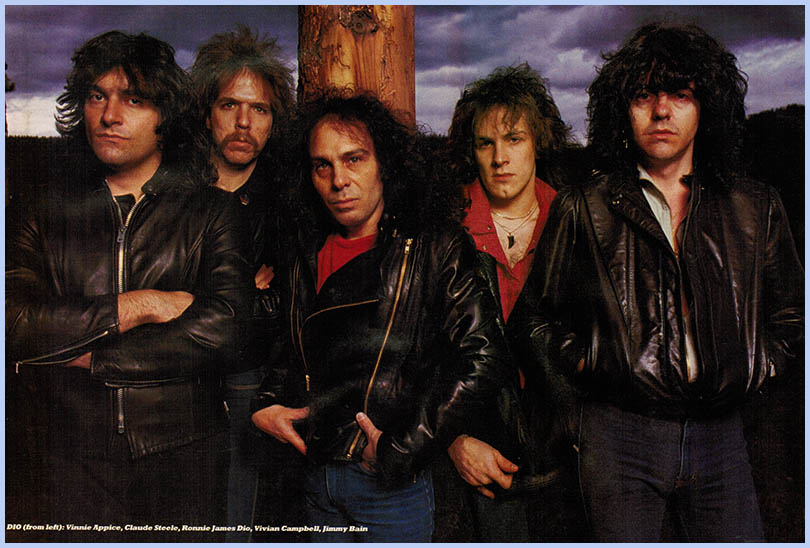 Looking back over the years, your career certainly has been something of an unpredictable affair. From Ronnie And The Prophets, through Elf, Rainbow and Sabbath to Dio, how do you view it yourself? "Yes, it has been a very strange career so far, hasn't it? But most of the things I've done have worked very, very well and luckily I haven't made too many people angry along the way, I haven't stepped on too many toes. I've tried to be a human being most of the time, especially to the fans, because they, after all, are the ones who buy my records and come to see me live, with the banners and all. So I never shirk my duty, I always try to sign autographs, to stay as long as I can after a show, because that's very important to me. I know that probably sounds like the kind of bulls**t that Iron Maiden or Saxon come out with, but I've got proof that I do it. I'm always there, doing my job." It's weird, but you're now probably bigger than many of the bands you've played with in the past. You're no longer the second string... "I like to think that's because my attitude has been correct all these years. I've taken time to worry about what the kids want to hear and I've always tried to maintain a young outlook. And yes, I think we have taken that step above Sabbath, that step above Rainbow... Rainbow were never the same band after I left. OK, admittedly when they had Graham Bonnet they were still playing strong music. But then they got in a singer who would have been happier doing MOR. I think that at that time Ritchie was desperately searching for some level of success in the States, and he thought that total commerciality was the way to achieve it. It was a shame, but he was wrong; Rainbow should have gone harder, heavier. With Sabbath, well, they are very self-destructive anyway, they never really took the time to care about the people they were playing for - with them it was just a day-to-day thing and 'How much money are we making?', and that was their big mistake, I think. Whereas with this band I've tried to take the mistakes that they've made in the past, that I've made in the past, and correct them by doing it properly. And, yes, as I say, I think it's worked, I think we are a bigger band now than either of them." If you were a cynical, vindictive person, you'd probably find all this immensely gratifying. "But I don't feel that way." But if you were... "Well, I must say that sometimes, sometimes, when I'm relaxing of an evening, I'll reflect on the situation. I'll think about the bad things that happened in the past, about the people I was involved with, about the people who - as you have suggested so kindly - are not quite as big as we are at the moment. And I'll admit that, yes, the corners of my mouth might just begin to turn up a little bit... But mostly I like to think about the good times, about how much fun it was to work with Rainbow and especially with Black Sabbath. You see, I like Tony, Geezer and Bill, I really do, I don't think they'll ever know exactly how much..." I notice that in the running order for a couple of summer festivals in Germany, you're billed above Ozzy Osbourne. That's pretty amazing... "Actually, to tell you the truth, I don't find it amazing in the slightest. Rainbow used to tour Germany a lot, Ritchie is an idol there, a star, a hero, and some of the songs we did in that band have become somewhat legendary in rock 'n' roll: 'Man On The Silver Mountain', 'Stargazer', 'Lady Starstruck'... we still play those songs." Do you envisage always paying homage to your past with Dio? "Yes, yes... with Sabbath numbers as well as Rainbow numbers. I happen to like 'Heaven And Hell' very much, I think it's probably my favourite out of all the songs I've written... it was something Sabbath had never done before, to play that well and write that well and that was very important to me. 'Man On The Silver Mountain' has become something of a trademark, I think it'd be foolish if I didn't do it live. As for the rest, well, 'Stargazer' and 'Lady Starstruck' I'm beginning not to care too such about any more but I'd always like to keep some connection with the past, and that's not just to please my older fans. Like today, I saw some shiny little 14-year old faces singing along to 'Man On The Silver Mountain'. and it was great..." Coming bang up to date, tell me about your upcoming new LP, 'Last In Line'. "It's twice the album 'Holy Diver' was, I think. Mind you, I've only just come around to forming this opinion. I thought 'Holy Diver' was a very, very nice first effort, so I didn't have to bother to try convincing myself that it was good. With this one, I don't know why, maybe it was because 'Holy Diver' had so much impact and we had something to prove... I just felt that it fell down in some areas. But now, after listening to it a few times, I'm really pleased with it. Very pleased." Your lyric writing sounds a lot more straight-forward, this time around. "Does it? Yeah... thinking about it, I guess you're right. But if you look inside the songs I think you'll still find the same old Ronnie Dio trying to come out, the man who doesn't seem to be making a point until you've heard the material a few times and you begin to say to yourself: 'Hey, yeah, I think that's what he means... I hardly ever make the lyrical message upfront. I think if you start force-feeding people with opinions, eventually they'll say: 'Aw. cut it out, we've got imaginations too y'know... People come up to me and say: 'I know what you wrote that song about, you were talking about so-and-so'. And I say: 'Yeah, you're right'. And then the next minute someone else will offer me a completely different interpretation. And I'll say: 'You're right as well'. The true meaning of a song only exists in the ears of the listener." OK. But could you offer your own interpretation of, say, the title track of the new album, 'Last In Line'? "It's basically a song about people who are looking for the answer to a question. I tend to cover this subject a lot; the 'Holy Diver' album sleeve dealt with this topic: What is good and what is evil? What does evil look like? What does good look like?" You got a lot of stick from religious factions over that cover. "Everyone said that it depicted a devil drowning a priest. But how do they know? How do they know that the devil wasn't disguised as the priest and vice-versa? That's on the outside - what's on the inside? "Are we evil or divine? We're the last in line.'I just wanted to write a song about people who have balls enough to go out and search for the truth, for the truth that matters. It's important to find out." How about the song called 'We Rock? On the surface it would seem to be little more than a simplistic anthem... "The only anthemic part of that song is its punchline. I don't write stupid songs. I don't consider myself to be a stupid writer or a stupid person. It's a song that says: 'We Rock. We had one like it on the last album, 'Stand Up And Shout'. I just happen to like numbers like that, numbers that aren't your traditional dyed-in-the-wool headbangers but which nevertheless give people a chance to participate. It makes no sense for 'We Rock' not to be on the album; I'm sure if the record had been on release and people had had the chance to hear it prior to today's show they would've been chanting 'WE ROCK! WE ROCK!' before we went out onstage. It's that kind of song - only, unlike many of its ilk, it's not insulting, its not condescending." To broaden matters out slightly, you've been around for a good many years now... "Yup!" How do you view the current rock scene? Is it thriving or dying? Growing or decaying? "There are too many people trying to jump on the same bandwagon... it's really got to an incredible point of sameness at the moment, particularly in the mode of dress, hair and make-up. Everything's interchangeable, no young, vital musical forces exist today. All the new bands seem to have to fit a mould: the bass player has to look like such-and-such, the guitarist has to look like Randy Rhoads... I don't think that's very exciting or musically progressive." You're talking about America here? "Absolutely, pointedly about America. Particularly the West Coast." (Which is kinda strange, because wife Wendy Dio is currently managing two new West Coast bands, Rough Cutt and Hellion. Ann Boleyn, Hellion's singer, even has a cat called Dio! Curious, huh?) "It's a shame, I don't mean to be so critical, but you asked me the question and I'm giving you an answer. I only hope, when the bubble bursts, we don't get dragged down by it all." If this happens, have you made any contingency plans? "No, I'll just carry on until nobody wants to hear about Ronnie Dio ever again. I'll always feel I've got a statement to make, I've got a big ego like everybody else who's been in this business for a long time. I'll continue to do what I'm doing until nobody likes it any more." How about the reformed Deep Purple? How about Sabbath, when they finally manage to confirm their new line-up? How do you think they'll fair aboard the bandwagon? "Well, let me take this one step at a time. Deep Purple were my favourite band, they made me want to do what I'm doing now. Ritchie Blackmore was the greatest influence in my life, I've got incredible respect for the man's musical intelligence and general intelligence. Now that Purple have got back together again, I want them to be incredibly successful. I'm sure that they'll make an album and that, technically, it will be a masterpiece. And then I think they will tour... and I think that tour will probably grind to a halt somewhere in the middle. I hope it doesn't, but it must be very difficult to leave a situation because of personal differences and then try to make it work again after all this time. I think that will be very hard. "With regard to Black Sabbath, well, it was wrong getting Ian Gillan in for a start. It was also wrong hiring Bev Bevan. It's not Bev's fault, he's a great drummer, but Tony and Geezer should have realised that they were Black Sabbath, not Black Purple or Electric Light Sabbath or whatever. What they should have done in the first place was to find a young singer, taken their time and discovered someone who wrote in a young way and who could really sing and identify with younger people. With Ian Gillan, Sabbath once again became dinosaurs - and that hurt me a lot, because I thought I provided them with a new lease of life. It was crazy for them to throw that away." I believe that (always assuming Jim Dandy doesn't get the job) the Sabs are searching for a young vocalist this time around. "It may be slightly too late. When you have too many versions of a band it becomes like, well, OK, so who's next? It becomes Rainbow again. But good luck to them." Going back to the subject of the Purps, I understand Blackmore is anxious for the band to return with as strong a record as the Yes comeback album, '90125'. "I think that's an awful attitude. Of course, it was a good comeback album that Yes made, I loved it, it was brilliant... but that was Yes. If that is Ritchie's attitude, then it stinks. He's saying: 'Look what Yes did, wouldn't it be nice if we could do the same?' Whereas he should be saying: 'Hey, we're Purple, let's go for it, we can take on the world!' Like, when I first joined Sabbath, Tony and Geezer were always moaning, always going: 'Oh dear, have we done the right thing? Is it going to work? Maybe we should have called ourselves something else... But I remember saying to them: You fools! This band is Black Sabbath, we can kill anybody, we're the best - we're part of a legend!' That's what Purple should be thinking, that's what Sabbath should be thinking now. That's what I thought when I was putting this band together. It's the right attitude to have, because for me it's worked... worked like a dream!" © Geoff Barton, Kerrang no 71 - June 1984  |