|
TONY CAREY Interview Vintage Music Geek 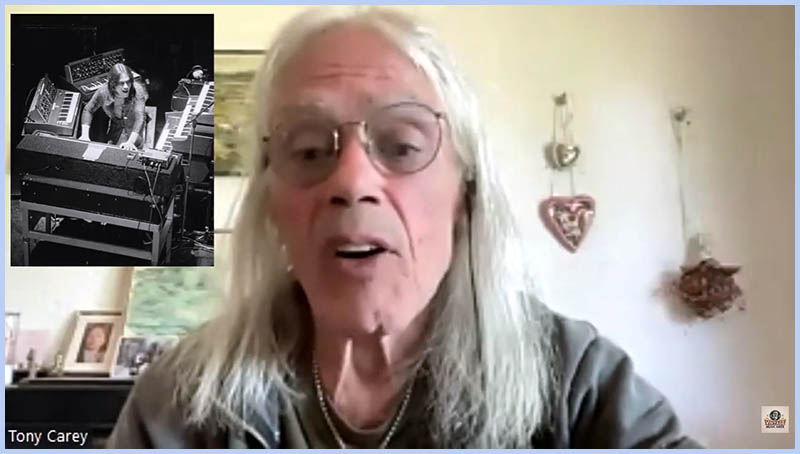 Before you joined Rainbow, you had this band called Blessings. And as far as I know you recorded some stuff with them and it was supposed to be released, but it hadn't happened. Do you have this records anyway? This recording? No, they were never finished at all. It was actually a million dollar record deal and I was a teenager. I'd had been living in Connecticut which is right by New York City and an ANR man from ABC Records heard a demo tape, signed us and flew us all out to Hollywood. They gave us Gary Katz as a producer who produced Steely Dan. And the first thing he did was fire the drummer, the bass player, and bring all these session people in. So we were recording with Jeff Porcaro on drums, Leland Sklar on bass and Jeff "Skunk" Baxter on guitar, the Steely Dan people. We could never get anything that he liked, that I liked or that anybody liked, on tape. We tried for 18 months and they spent money like it was... they were trying to burn it. We lived at the Chateau Marmont Hotel on the Sunset Strip and at night we lived at the Rainbow Bar and Grill, which is on the Sunset Strip in Hollywood. So, it had gone this 18 months and nothing was even close to being finished. I was rehearsing in a commercial rehearsal studio in Hollywood with Jeff Porcaro, Mike Porcaro and I think Steve Lukather and I was playing keyboard, not singing. I was playing Hammond with Blessings. And Ritchie was two studios down looking for keyboard players for Rainbow, because he had done the first Rainbow album and wanted a band that looked like rock and roll stars actually, because the band that he used for the first record was Ronnie's band, Elf. And they were good. They played well, fine, but Ritchie was looking for more of a look. He had Ronnie, Cozy, and Jimmy, but he could not find a keyboard player. And he flew ... I don't know how many people, but 50 people auditioned for that job. I thought it was perfect timing, because if the Blessings project had progressed normally, we would have had an album out and I would have been touring and I would have had obligations. This was actually the perfect time for me to say this is really boring, let's do something. So when they asked me if I'd like to audition, I said, "Yeah, yeah." And that broke up Blessings, of course. Cost of ABC Dunhill was a couple million dollars, but they didn't care. And off I went. What exactly you played on the audition? Can you remember what... Yes, it was really funny. We auditioned in a Sound Stages. One of them was called Pirate Sound and it's like an airplane hanger, huge, enormous building with a really high ceiling. I think they filmed "the Wizard of Oz" there, or famous movies and they had turned it into a rehearsal room, with a full concert PA, not like a little room where you sit around and rehearse, but like a venue. It would have held 4,000 people. It was huge. I came in a little early, there was eleven keyboards set up and a spotlight on the keyboards. So I said, "Fuck it." And I just went over and warmed up one keyboard to the next to the next and played for about a half an hour, a long time. And I didn't know this, but the rest of the band was in the back of the room, watching me. So after I said, "Well, everything works. Where is everybody?" Somebody came to me said, "Okay, you've got the job. Do you want to join the band?" I said, "Yeah, that's why I'm here." And it was fairly bizarre, because I didn't meet anybody first or bring any equipment. I just showed up and all this equipment was there. So I just started playing, really loud, and they had this enormous concert PA. It was really loud. I know that. I blew the walls down and I guess they like it. I know they liked it and they asked me to join a band. The first time that you played with all the band, was... in the studio that day? Well, yes. I mean the whole band was set up, because they'd been auditioning keyboard players for weeks. So all the amplifiers and drums, everything was there and the keyboards on the left, but nobody to play them. So right after I said, "Oh, it sounds good. Let's play." Then everybody plugged in and we played. And from then on, that was Rainbow. As we are talking about Rainbow, your keyboard parts made big impact on "Rising" ('76) album, also on "Long Live Rock 'n' Roll" ('78) album, also on this album you recorded your parts. These albums are considered now as hard rock classic albums. They made big impact. A lot of metal bands, power metal bands. What are your memories from recording studio, when you for example recorded "A Light In The Black"... We would do it this way. Ritchie, Jimmy and Cozy would play a track until they liked it. I wouldn't play with them and then somebody called me. The studio was in the basement of the hotel in Munich. It was the Arabella Hotel. Led Zeppelin had worked there, Elton John. Everybody worked there. So they call up to my room and said, "Come on down, take the elevator down and we'd like a keyboard intro and we want a solo here or we want this here." I said, "Okay, you go, leave me alone and come back in two hours." And that's how we did it. I worked with Martin Birch who was producing and engineering. Nobody bothered me. And when Martin and I thought something was acceptable, good, he'd call said, "Come down and listen." They'd listen, said, "Great. What's next?" And we did it. So for me actual physical recording time, might have been 6 hours, 7 hours, not much longer... In one day? No, we were there for two weeks. It's my first time in Europe and it was enough to do in Germany. Germany is a big exciting city. Especially in the 70s. Drugs, women and clubs and all that all around. So, I enjoyed every minute of it. But actually, when it comes to playing, I mean, I did the "Tarot Woman" intro, it was one take and then the hard part, there's two synthesizers on that. And this was before people used click tracks and metronomes. So the hard part was doubling it and make it sound like I was following a conductor and I wasn't following anything, except what I kind of remembered that I just played. And that's what took the longest. The actual intro took... how long is it? It's a minute and 40 seconds. Whatever it is. It took maybe 20 minutes and then maybe an hour to put the second part on. Then it was done. And "Light in the Black". Ritchie wanted a solo. I played one in a... See, only time he ever said anything to me. I played one in a what I consider to be a Minimoog range. High. And he came in, he says, "It's good. I like it, but could you try it way lower?" I said, "Yeah, sure. Go away. Come back in a half an hour." And that's the one we kept. It starts off really low, goes back down really low. And then we had worked out this line. We had worked that out in the rehearsal studio, so that was no problem. He played it first and then I just put my part on and played it with him in harmony. And it was that easy. Nobody ever said anything basically, you know, critical. They made a couple suggestions. I understand the vocal sessions now. And then I went home and Ronnie sang and I understand that was a lot more difficult, cuz Ritchie was of course in the room with him, with Martin, while Ronnie was singing and a lot of discussion I imagine. Much more difficult than my session or Jimmy's. I mean Jimmy play a song and he's finished basically on a bass, or a Cozy... but Ronnie had definitely the most work. Ritchie did a couple of days of guitar overdubs, but very simple guitar overdubs... Well, except for I think he played his best solo ever on "Stargazer". That's my favorite solo that he ever played. I think that took a whole afternoon, maybe even. You know, he tried it a lot of different ways, until he found what he liked. But I played my stuff. I mean, a lot of times I'll tell people I did that album in 10 minutes. I mean, 20 minutes, cuz it was kind of had that feeling. But then the music was finished and Ronnie had sang. Cozy had a tape which I got a copy of, which they later released on the deluxe edition. It sounds just like the record. It is just like the record, except that we had two introductions. There was also an introduction for "Stargazer", but it doesn't make any sense at all to have two minimoog introductions on a six song record. So I just said keep what you want and they kept these parts. I think you said also about it, that in the concerts, while you were performing with Rainbow, it was quite different than... the songs sound differently (than studio versions), because you were improvising. You like this improvising vibe, like on one of your favorite records "Bitches Brew" from Miles Davis. Exactly that. Yeah. So generally, you have it on the mind this album and you... I don't have it on my mind, but it changed my life about playing live. I mean when I heard "Bitches Brew" I was 16 and I already had a band. My view of playing live was to learn a song and then play it every time the same way. Then I heard "Bitches Brew" and I saw Miles twice and realized, that it doesn't have to be that way. You could just play what you feel on any night and if the people like it, great. If they don't, fuck them. Play what you feel. And that's what music is. Channeling some kind of emotion from the sky, through your brain, fingers, through some speakers. And that's basically what it is. I saw Miles play I think two hours. I think with three songs and he would just sit there, coolest guy in the world, with his red trumpet and he'd just point to somebody and they play. You know, point to Herbie Hancock, he'd play Chick Corea, he'd play. Jack DeJohnette on drums, he'd play. Just amazing, the whole thing improvised. They had -as did Rainbow- parts that had to be there. I mean, there's a verse and a chorus, but everything else is always improvised. Ritchie never played the same solo twice. I never played the songs the same way twice. If you listen to any of the bootlegs, and there's a bootleg for every concert I think we ever did. You'll see that I don't ever play the same thing twice, or repeat myself, which is how it should be, because I don't want to ever have the idea that music is work. They say we don't work music, we play music. It's the difference between working and playing. And when you're playing, just let it out. Whatever is in. And that's why sometimes "Catch the Rainbow" would be seven minutes long. Sometime it would be 18 minutes long. And it didn't really matter. Or the same with "Stargazer". Sometimes it would be a quarter of an hour and sometimes it would be 8 minutes like the record and just depends what the energy level was, what the audience was giving back in terms of energy and so I didn't consciously have Miles Davis "Bitches Brew" in my head, but that philosophy of how to play music, became a part of how I played music when I was a teenager. You listen to these albums and somehow, anyway they influence you, even if you don't think about it. Everything I ever heard, I've stolen. Every single thing I've ever heard, has influenced me from.. if it's from Béla Bartók or Igor Stravinsky, or Iron Maiden. I've stolen everything I've ever heard, because that's what music is. It's a universal language. I don't steal lyrics, but as far as music and playing, I don't even think about it. I play what I want to play. And if it's the same thing, that Rick Wakeman wanted to play 40 years ago, that's the way it is. These are good examples. You can just steal from them as you said steal in the "brackets". Everybody, any good musician is influenced by anything he hears really. I mean any pop song, any disco song, any jazz, anything that goes through you and wakes up some kind of emotion, that's an influence and that will show up later, definitely for all of us basically. Even if you are talking about how long your songs lasts. Now I'm checking "Live In Köln 1976 at the Kölner Sporthalle". This was rereleased lately. I can see it on Spotify and for example, I see "Mistreated" 15 minutes, "Catch the Rainbow" around 14 minutes, "Man On The Silver Mountain" 12 minutes. Almost all the songs, lasts more than 10 minutes even 15, 20 minutes. Our whole setlist was I think eleven... I think we knew eleven songs, but we didn't always play everything. Sometimes we didn't play "A Light in the Black". Sometimes we didn't play "Do You Close Your Eyes"... During your time, when you were in Rainbow, you also recorded as a guest on some albums. For example, on Pat Travers album "Putting It Straight". Can you recall how this had been recorded? He was rehearsing with his band at Pirate Sound Studio in another room... It might not have been Pirate Sound. It might have been the other rehearsal. Anyway, someplace he heard me play and he was in town to to do a record and he said, "Come by the studio and play something on my record." Yeah, sure. And I did that in about 20 minutes, I think it was a minimoog solo. Around the same time I think, it was Geff Harrison, the singer from the German hard rock band Kin Ping Meh. But you know what I did on that record? I played bass. That's all I did. I didn't play keyboards. My very good friend, the drummer, called me up and says, "We're in the studio. We don't have a bass player." I said, "Okay, I'll come over." And I brought my bass. And I did the whole record in two hours or three hours. So he's got bass, but otherwise there wasn't a bass player, so I said, "Okay." You worked with Ritchie's (Blackmore) son for a short time. It was this band Over the Rainbow. I can say you're... Yes, with Joe (Lynn Turner) and Jürgen Blackmore. It was for very short, because I think than you were struggling with your illness. No, I got sick right in the middle. As a matter of fact, we did a tour of Russia, 16 shows. Did really well. We were playing arenas. And then I got a cancer diagnosis. The doctor said ... and so, you know, I couldn't do it anymore. That's all that was, I got sick. I couldn't do it anymore. So they got Paul Morris. Who had played on one of Richie's, I think the last... "Stranger In Us All", on this album. Bobby was still there - Rondinelli and Jürgen Blackmore, Joe (Lynn Turner) and Greg (Smith) bass player, who also plays for Ted Nugent. Actually a lot of people, he plays with Tommy James and the Shondells in Las Vegas. It's so funny and it's so great for me... It's maybe hard to compare son and father, but I'm wondering how it was to work with Jürgen if you compare it to working with Ritchie, can you tell the difference between these two? Well, Jürgen's German. He's not British. And in fact he's got a British passport, but he's German. And I know Germans. Jürgen and I were great friends right from the beginning. I'm older than he is. He's funny. A funny guy. He's a really good guitar player. He's not Ritchie Blackmore. Nobody is. He never will be. Nobody will be. Ritchie Blackmore invented... Well, Hendrix but Ritchie Blackmore was the best showman I ever met, or saw. Hendrix of course, but then Ritchie and it was like night and day. I mean, Jürgen is just a nice, lovely person and I know his wife, I know him, his kids, and his dog. It was all fine. We laughed all the time. And it was a completely different experience. You have to remember, that when I worked with his father, that was the first time I ever played hard rock music, or even thought about it. Blessings was more of a country band. Like the band America, or Neil Young with Crazy Horse, in the very early... like "After the Gold Rush" ('70), those early albums. Blessings got that record deal that got me to Los Angeles, it was more of that kind of a group. So, I never played any hard rock or anything, but I did see... I was living in Los Angeles. It was 1974 and Deep Purple played the California Jam, that's where Ritchie got the idea for the rainbow, over the stage and Ritchie smashed his guitar to bits and blew up his amplifiers. And put way too much explosive, somebody did in the cabinet that blew up. It blew Ian Pace's glasses off, 30 feet away. It lit Ritchie's pants were on fire. He was dancing to put up his pants, that were on fire. And I thought at the time, I never even suspected, I'd ever meet him or work with him. I thought that's rock and roll. I like that. That's great. So, generally few years later, you worked with him. You saw him on the stage and then you hadn't thought that you would be with him in the band. Yeah, they broadcast it. It was such a big show. It was like 400,000 people. They live streamed it on TV. In LA anyway, and I was living in LA, so I watched it. Emerson Lake and Palmer and Black Sabbath all that. But then, Deep Purple was the biggest band in the world in 1974. So, I wanted to see what all the excitement was with Deep Purple. And I'd heard Made in Japan. I knew it's exciting band, but I didn't realize, what a show was going on. And Ritchie was the best showman I ever saw. After Rainbow you played lighter music. I mean in the solo albums. Soft rock, pop rock, not hard and heavy. So, you didn't want to play that kind of music then or... No no... You know what I can do really well is bluff. I'm a really good bluffer. Ritchie would tell me "Play something that sounds like Bach" and I play him something. It's not Bach, it's bullshit. And he believed it. I mean, I knew what he was looking for, cuz I knew Deep Purple. I knew he was looking for a really loud, aggressive Hammond organ guy actually to replace Jon. And I can do that. I could always do that. That's a lot of fun. But I also brought synthesizers into his life. Jon played some synthesizers, but not very... they weren't really featured and they weren't special. Jon was special on the Hammond organ always. But I never considered like being a hard rock guy or playing hard rock music. I can't sing that high. You got to sing high. You got to sing as high as Robert Plant or Bruce Dickinson or Ronnie Dio. You know, if you're going to do that kind of music. I can't do that. © Vintage Music Geek - July 17 & August 2, 2026  |