|
Ritchie Blackmore Interview at the Drake Hotel - November 13, 1975 Jean-Gilles Blum, our secret agent in New York, met guitarist Ritchie Blackmore, who was performing there with his (already) revamped new band, "Rainbow". Listen to him, it's exclusive... LIVE RAINBOW 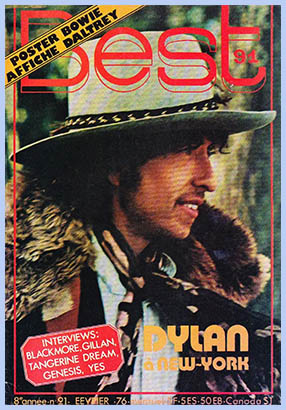 Ritchie Blackmore had just started the first tour of his new band, Rainbow, when he stopped in New York for a concert at the Beacon Theatre. It was actually the very beginning of the tour, New York being their third concert. Since his last album, Blackmore has changed his lineup. From the band Elf, which used to back him, only singer Ronnie James Dio remains. Speaking of Elf, those guys opened for Deep Purple for seven tours and recorded an album produced by Roger Glover. It was during these tours that Ritchie Blackmore and Ronnie James Dio got to know each other. Apart from him, the new group consists of Cozy Powell, an excellent, well-known drummer for his sessions with Mickie Most, Donovan, and Tony Joe White, plus his work with the Jeff Beck Group (the Rough and Ready album) and the release of three solo 45s, "Dance with the Devil," "The Man in Black," and "Na Na Na," which were quite successful in England. Scottish-born Jimmy Bain plays bass; he worked with John Lee Hooker in the US and Canada, as well as a band called Harlot in England. The last member, Tony Carey (keyboards), is a Californian studio musician met by chance in LA.
Blackmore's new album offered us some good Hard Rock. His concert was much the same. Blackmore still hasn't lost his bad habits; he makes the crowd wait over an hour just to rile up the room. The music is exactly what was expected and brings nothing new. Opponents of Deep Purple (and there are many... despite the surprise of Come Taste the Band) hoping for something new will be disappointed by Rainbow's stage performances. Furthermore, it must be stressed that they play incredibly too loud. I swear I've never seen anything like it. At the Beacon, they nearly blew the eardrums of those in the front rows, who couldn't stand it and mostly had to move. The next day, Blackmore seemed to ignore these sound system issues; after all, let's hope it was just a technical adjustment. In any case, for their tour in France in March, I advise you to bring cotton wool — you never know. Aside from that, the band's cohesion is excellent. Ronnie James Dio undoubtedly has a major stage presence, while Cozy Powell's drum work is mind-blowing. As for the other two, they are more in the background, though they provide a dynamic rhythm section. Rainbow hauls around an impressive light show with strobe effects, a glowing rainbow arching over the stage, and the whole grand spectacle. When all is said and done, they put on a show that is a pleasure to watch. The setlist consisted entirely of new tracks, all taken from the album except for two unreleased songs. In particular, the final song, which is promised for the next album, shows great potential — it was by far the best piece of the concert. It lasted half an hour, including a drum solo by Cozy Powell backed by Tchaikovsky (1812 Overture) and Blackmore improvising wildly. It is during moments like this that the band really takes off. Blackmore is an outstanding guitarist, and if he pushed his creative boundaries a bit more, his albums would be far more interesting. Aside from some real guitar-shredding, his intros are all highly successful, both in "Man on the Silver Mountain" and "Sixteenth Century Greensleeves." They also played the two slower tracks, "Temple of the King" and "Catch the Rainbow," before slipping away to "If You Don't Like Rock 'n' Roll," during which the old walls of the Beacon came close to crumbling down. THE INTERVIEW The following evening, I had an appointment at the Drake Hotel — a highly exclusive spot — to interview maestro Blackmore. The meeting was set for eight o'clock, but Ritchie was supposedly "not feeling well" (my foot!). You can't miss out on good opportunities in New York, so I went to see Little Feat at the Beacon instead and returned around midnight, expecting to be turned away once again. But, by some miracle, Ritchie came down to the Drake's bar, where unfortunately it was impossible to take photos. He was accompanied by a few friends (male and female) and Ronnie James Dio, a very "PR-friendly" character. After Paul Kossoff and Tommy Bolin in the "Hard Rock Guitarists in New York" series, here at last is Mr. Ritchie Blackmore. 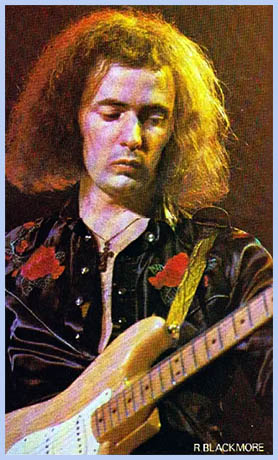 So, how is the start of this tour going?
NY was only our third gig, so we've only just begun, but for a start, it has gone very well. The first gig in Montreal was very difficult, and I must say we were all a bit nervous before going on stage. Fortunately, it turned out well. Are you satisfied with last night's concert? Very. Of course, there are a lot of minor issues to iron out, but it will come together bit by bit. The crowd's reaction was good. By the way, I'd like you to clarify that if we take so long to come back on stage for an encore, it's because we have to. The end of a concert is the end, and theoretically, we have no reason to do another. Every time, we are practically forced to return because we're afraid the kids will get angry, and that's not what we want either. I felt there were serious sound system issues. Oh, really? That's possible, and it's common at the start of a tour. Unfortunately, I don't hear the same sound the audience does, and I don't know what the crowd is getting. I'll go check on that for the next concert. For these first gigs, the chemistry seemed excellent to me. Do you agree? Absolutely. We even improvised on the new song—that was a first. Jimmy and Tony are experiencing some issues, but that will come. One thing that annoyed me yesterday was that we couldn't get close to the audience because we risked getting hit in the face by the rainbow; the roadies hadn't secured it properly. It seemed ridiculous... Are you pleased with the album? Musically excellent. The musicians who played on this album were only hired for the recording, and that was planned. I didn't fire anyone; I knew the concerts would be done with a new band. Now, sales-wise, it is doing very well in the States and everywhere else, except for France and Germany. Mind you, it was only released in France three weeks ago, so everything could still change... Do you plan to return to smaller venues with Rainbow? Definitely, venues for about 3,000 people. I'm fed up with massive "gigs" for 50,000 people. The conditions are terrible; it's impossible to establish any communication with the audience. I like to be close to them and feel them react. In those massive shows, it's impossible—the kids pay a lot of money and don't get their money's worth. How did you meet the current members of Rainbow? We did the studio work together (with Ronnie). When I wanted to form the actual touring band, I remembered an old drummer friend, Cozy Powell. I had met him at a seance. Then, still with Ronnie, we looked for a bassist. We had heard about Jimmy and found out he was playing at the Marquee. So we took a plane from Hamburg to London, and he impressed us so much that we immediately offered him the job. Tony Carey, he's only been in the band for two months; we discovered him in Los Angeles. He was rehearsing in the studio next to Led Zeppelin's. We heard him, and the next day he came to play with us, and that was it... Returning to the seances you mentioned, do you see a connection between them and your work as a musician? Without a doubt. On stage, I'm somewhat in another world; the direct contact with the audience and the excitement take me very high, it's hard to explain. Why did you leave Deep Purple? I was bored. I needed something new to get me going again. I felt the need to create new sounds. That's why Rainbow doesn't play any Deep Purple songs. I am well aware that people come to see us hoping to hear "Smoke on the Water", but that would be too easy and uninteresting. Actually, I almost left Deep Purple much earlier, up until Ian Gillan and Roger Glover left the band; things weren't working at all anymore. Roger and Ian were fed up, and I think if they hadn't left, it would have been up to me to say goodbye to everyone. It was a crisis period for Deep Purple. What do you think of Coverdale as a singer? He's a good singer, but he lacks confidence; that will come. Ian (Gillan) was better, though. Still, that didn't stop "Burn" from being excellent. I somewhat regret the release of "Stormbringer"—it's the weakest Deep Purple album; it was OK, but nothing more. 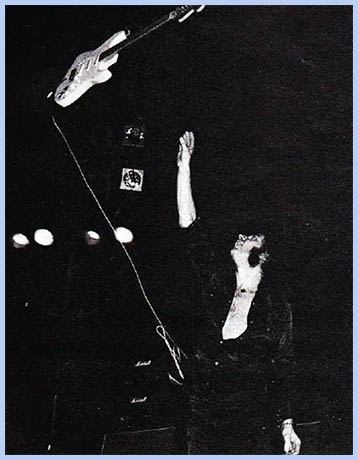 What was the best Deep Purple album?
Without a doubt "Machine Head." We did a superb job on that. How are your relations with the band at the moment? My departure was a bit of a blow to them, but we have remained very good friends. I'm happy for them with the result of "Come Taste the Band." Tommy Bolin surprised me; he is very good... What were Deep Purple's best concerts? Contrary to what everyone believes, the most famous concerts like California Jam or the ones on "Made in Japan" were not the best at all. California Jam is famous because I smashed a guitar there, and as for the Japanese concerts, they were very strange. In Japan, the audience only applauds at the very end of the gig. The first time in Tokyo, we wondered what was going on—dead silence. We left the venue disgusted and went back to the hotel, only to find out that the crowd had started applauding and wanted to tear the place apart because we hadn't come back out. Your last concert with Deep Purple was in Paris. Do you have fond memories of it? The only pleasant thing I remember is that I saw my former girlfriend again... You have been influenced by sixteenth-century music lately, haven't you? That's partly from working with Ronnie, although I have always liked German baroque music and I've always loved Bach. Rainbow tries to interpret this in its own way and will go even further on the next album, planned for March. Ronnie James Dio: I have to say that all the credit goes to Ritchie on these tracks; he plays over twenty-five chords, it's like an orchestral score on a guitar. Did you like Jon Lord's classical work? I can't really say. I played on Gemini Suite and the concert at the Royal Albert Hall; I just played, that's all. You are very attached to Germany. Is that because you lived there before working with Deep Purple? I lived in Germany for a very long time, I have many friends there, and I love recording there because the studios are excellent. The German public is very critical; our concerts there are tough tests to pass. Before Deep Purple, when you were in Hamburg, where did you play? All over the place, but I was often at the Star Club backing just about everyone. I had the chance to play with Jerry Lee Lewis; that was very interesting. Going even further back into the past, what do you think of your work with Lord Sutch? That guy is incredible. He has disappeared from the scene now and spends his time in the bars of Los Angeles. He was the first to have hair down to his shoulders. Every concert was an adventure; he taught me how to move on stage, how to express myself, and how to project my music to the audience. It was a wonderful experience. Who are your favorite guitarists? Do you want a funny answer? Why not? Jimmy Page, or even better, B.B. King (with a very serious look). -- Ritchie decided that the interview was over; he's chatting with his friends and is no longer listening to me. I turn my attention to Ronnie James Dio, a very open character who is eager to go to Paris to buy some clothes. As we leave, Ritchie calls out, "see you guys in Paris". © Best Magazine, France issue 91 - Februari 1976  |