|
Ritchie Blackmore Special Interview with Ritchie Blackmore  RAINBOW's first Japanese tour in 11 years has successfully concluded, leaving many fans deeply moved. On November 23rd, after finishing the final show of the Japanese tour at the Bay NK Hall, Ritchie Blackmore returned from the venue to his hotel and agreed to do this interview right away. It was incredibly gracious of him to accommodate the interview so smoothly. At first, he suggested doing it at a bar, so I went ahead to the designated spot to wait for him. However, some band was playing at that bar, cranking out familiar tunes like "El Cóndor Pasa" one after another, making it an atmosphere where an interview was utterly impossible. When Ritchie finally appeared, he shook my hand, smiled warmly, and made a wonderful suggestion: "It's too noisy in here, let's do it outside." Needless to say, I was delighted to follow his lead.
Thank you very much for the interview back in Long Island. Thanks to that, your side of the story was accurately conveyed to the fans, and I'm very glad about that. That's good to hear. You've been touring continuously with this new band. How are you feeling right now? Well... I'm tired (laughs). We've been touring for nearly three months now. But so far, everything has gone extremely smoothly. In '96, we might tour Eastern Europe, and South America as well. Anyway, up to this point, things have gone perfectly. I'm satisfied. Once you actually hit the road on tour, I imagine the strengths and weaknesses of the band members become quite clear. At this point, what is your evaluation of them? In my case, I usually judge based on the audience's reaction. I look at how the crowd evaluates them. Of course, I have my own opinions about each member, but for the most part, I keep them to myself. Well, let's wait and see for a while. Let's see if this band is still together six months from now (laughs). At that point, what I'm currently thinking will become clear. Right before the tour started, there was a change in drummers. When I interviewed you in Long Island, John O'Reilly seemed to be getting along very well with you... Yes. With John... there were two circumstances. First, he was playing soccer and hurt his collarbone. Second, he seemed to have second thoughts about going on a long tour away from his family. That was the hard part for him; he apparently felt some reluctance about leaving home. He hadn't anticipated being out on the road for two months straight. The first show I saw on this tour was in London, and I thought Chuck Burgi was as wonderful as ever. When you realized John couldn't continue, did you contact Chuck right away? Yes, that's right. Chuck has been one of my favorite drummers for a long time. He knows how to swing. While there are many drummers who play in a very rigid, tight way, he swings like this (snaps his fingers). Some drummers play mechanically like robots, but Chuck has been doing this a long time and knows how to apply sophisticated accents. He emphasizes specific beats to match my playing. There aren't many drummers who do that. It's called syncopation. He really knows how to utilize excellent syncopation. 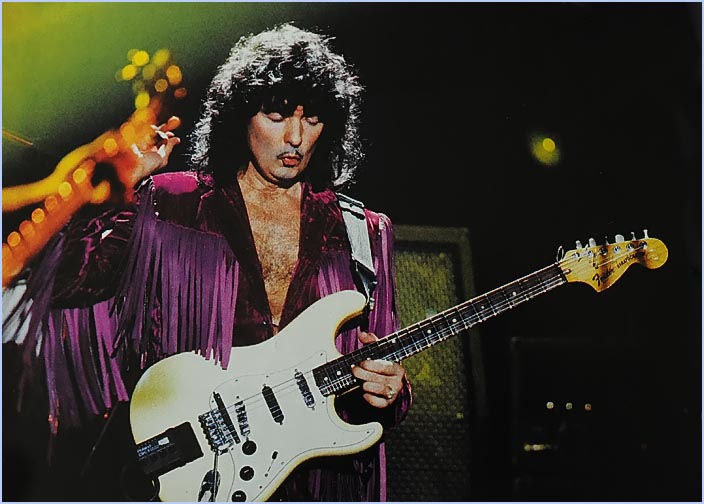 In Japan, many fans look back fondly on the RAINBOW era when Cozy Powell was the drummer, but I get the feeling that Chuck is a drummer who allows you to do what you want to do more freely. Yes. Chuck is exceptionally outstanding among all the drummers I've ever played with. If I were to compare... well, Ian Paice is also excellent. Both of them swing. They belong to a different school than Cozy Powell. Cozy Powell is very much a showman type. He's in the same vein as Bobby Rondinelli. He has a lot of showy moments and hits incredibly hard. But that doesn't necessarily mean he's a superior drummer. In my opinion, playing like Cozy's is too stiff. On the whole, it's just rigid. (Taps on the table at rigid, monotonous intervals) That drove me crazy. I like a swing like this (snaps fingers). And well... I stopped playing with Cozy in 1980 and brought Bobby Rondinelli into the band, but as far as I'm concerned... Cozy can be a very nice guy, but at the same time, he can be very stubborn. So, I drew the curtain on that brief chapter. On this tour, the setlist changes almost every night. When do you decide on the songs? There are parts we decide right on the spot. Normally, everyone knows all the songs to some degree, but we properly rehearsed and prepared tracks like "Street Of Dreams" and "Stone Cold." We might even play them at the next show. Since arriving in Tokyo, we did a two-to-three-hour rehearsal. We didn't play those songs in Europe, but coming to Japan, I realized everyone knows those tracks much better than the people in Europe do. Even though they weren't particularly major hits. For me, including those songs keeps things feeling fresh, so I freely weave them in wherever I think they fit. I refuse to go out on stage night after night and play the exact same songs. You need to have a little freedom. I suppose it's the part where you use your brain. If you don't create variety by mixing in different songs, doing the exact same thing every night would drive me insane. There are bands out there like that, but I can't do it. I can't just keep doing the same thing. We've already performed many of these songs countless times over the years, so that alone is challenging enough. Sometimes I practically forget what I'm playing because I've become so completely desensitized to the song. That's why some level of variation is necessary. For "Long Live Rock 'N' Roll," you've dropped the key lower compared to the version Ronnie James Dio used to sing. It's in E now, right? Yes. Ronnie's voice was much higher. Doogie (White) can't sing that high. It's possible, but it puts too much strain on his voice. In that case, it's much better to lower it. We are playing it in E now, but I think Ronnie did it in G. Joe Lynn Turner also did it in E, though. This isn't the first time we've lowered the key. Playing in a different key can be confusing at times, though. The original key is still wired into my brain, so if I suddenly lapse back into the feel of the original key on stage, I lose track of what I'm doing. However... we've been playing it in the key of E for two months now, so I've gotten used to playing it in E. Though it really should be in G. From a guitarist's standpoint, do you prefer to play it in the original key if possible? Or do you have no resistance to lowering the key to accommodate the singer? For that particular song, I think it's fine. The song we always struggled with was "Man On The Silver Mountain." We tried lowering it from G to F, but it just didn't sound good in F, so we had no choice but to do it in G. We did give F a try, though. But it was no good. Something felt off. Actually, I found it curious that you lowered "Long Live" but kept "Man On The" in its original key. Now I understand. Hahaha. Exactly. For "Still I'm Sad," we ended up doing it in the key of E on the record, but that wasn't Doogie's key either. It was too high. Now we do it in the key of B. This fits his vocal range much better. We should have done it in the key of B on the record too, but that track was basically a joke to begin with. We did it without a second thought and didn't take the time to test which key was best. When we listened to the finished product later, it was too high. So, I sat down with him and tried almost every key. I told him, "Just try singing it like yourself. I'll adjust to you," and he sang it in B. That's what we are doing on stage. Because of that, his performance on stage should be much better than on the record. It's wonderful to hear "Temple Of The King" performed live by RAINBOW, and Doogie's vocals really shine on that track. Was it chosen with that in mind? Doogie was the one who wanted to do "Temple Of The King." At first, I refused because I didn't really want to do it, but he sang it during a rehearsal one day, and it was incredibly good. That's what made me want to give it a try. When he first suggested doing that song, I wasn't keen on it at all... but because Doogie kept singing it during every rehearsal, I was eventually swayed by it. It seems that song is better known in Europe than in Japan. At least in Europe, everyone sings along with Doogie. Hearing "Burn" and "Smoke On The Water" done in the style of the versions David Coverdale and Glenn Hughes used to sing is very intriguing. Exactly. It certainly is intriguing. Since we have two vocalists now, we can handle the harmonies required for a song like "Burn." When it came to deciding the setlist, what did you prioritize the most? Which songs are the best, which songs everyone knows... you just sort of know that somewhere in your heart. First of all, you need up-tempo songs. You can't just play one fast song and then keep things slow until the end, so you have to throw in another fast track... I didn't really need people telling me what to do to figure out what was best to play. What we're doing now is the best selection compiled from all our material. Doogie wanted to do a lot of Ronnie Dio-era tracks, but I'm not particularly fond of that. He said he wanted to do "Kill The King" and a few other songs, but I declared, "I'm not doing it" (laughs). If we're going to do that, I might as well call Ronnie Dio up to sing them. The main point for me was not to simply rehash old RAINBOW tracks. A little bit of the old stuff, a little bit from the middle era, and a little bit of the new stuff—and then blend it all together. I didn't want to just dig up old material. Because personally, I'm not a huge fan of old songs. They were fine for their time, but when I listen to them now, I think, "Hmm... I don't really like this." I assumed that tracks like "Lost In Hollywood" or "Eyes Of The World" sung by Graham Bonnet were left out because Doogie couldn't sing them... That's not true. "Lost In Hollywood" is left out simply because it's a song I dislike. Well, "Eyes Of The World" was a good song... if I wanted to do those tracks, I would have just changed the key to do them, but since I don't care for them all that much, I didn't even consider it. Have you ever heard Ronnie sing "Man On The Silver Mountain" or "Temple Of The King" with DIO? No. I haven't heard it at all. I don't really follow what they do. 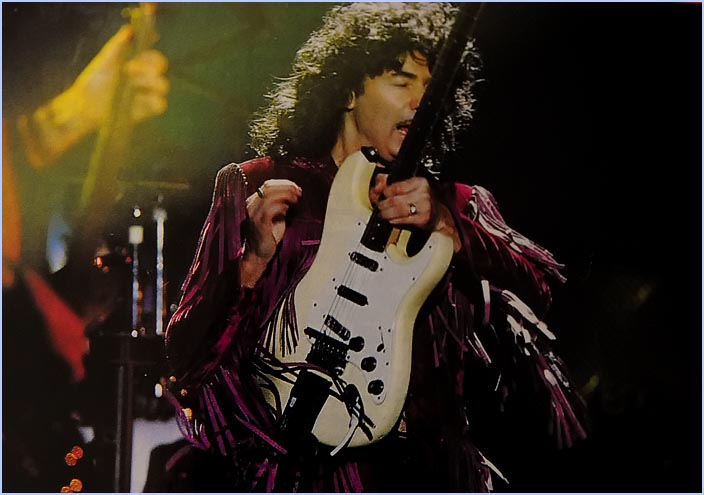 Old-school RAINBOW fans still cling to the dream of Ronnie returning to the band. He commented in an interview himself, saying, "There are no such talks, and even if there were, it's unthinkable," but... I haven't thought about it either. Because my music is... in the past, I never even contemplated doing this RAINBOW again. I hadn't imagined doing RAINBOW once more with any kind of lineup. In other words, my intention wasn't to just play old RAINBOW songs from that far back. It's much more preferable to play something new and move forward, rather than constantly playing nothing but the same old stuff. I'd rather play something more modern—even though I haven't managed to write those kinds of songs just yet. At any rate, the kind of RAINBOW music I have in mind isn't in that Ronnie Dio style. So, I have no intention of asking him to be the singer. In London, you also performed "Black Night." Is showcasing so many DEEP PURPLE songs done "for the fans"? Or is it because you personally want to play them...? Whether it's DEEP PURPLE or RAINBOW, the point is that it's a collection of songs I'm widely known for. This is also one of the enjoyments of what I'm doing now. It allows me to extract the very best parts of DEEP PURPLE and the very best parts of RAINBOW. I think RAINBOW has plenty of mediocre songs, and DEEP PURPLE has plenty of mediocre songs too. So, I am bringing out the finest elements from both. Regarding "Burn," I was delighted to hear a proper version of it after such a long time. Of course, Ian Gillan would never sing it, and while Joe (Lynn Turner) sang it for us, it was quite a struggle for him... I also thought that Joe would be able to sing "Burn," but... It just wasn't the right song for him to sing. It was a bit too high. Ah... yes, you're right. It might have been too high. In that sense, your choice this time around was the correct one. I see. I agree. However, when it comes to Doogie, one could take a negative view and say, "He has a good voice, but he's a bit weak on stage." Also, some say that while his stage movements would suit IRON MAIDEN, they aren't very "RAINBOW-esque"... Yeah, I think so too sometimes. Every now and then (laughs). Even a singer who sounds wonderful on record, like David Coverdale, often didn't live up to that on stage... Is working with that type of singer frustrating for you? It certainly is. Finding a suitable singer is an immense ordeal. How should I put it... someone who can sing properly and carry themselves in an appropriate manner on stage. There are all kinds of moods floating around on a stage, and you have to maintain your composure within that. Running around like a chimpanzee or a monkey just won't cut it. For example, David Coverdale used to think of himself as incredibly sexy, but it ultimately came across as very effeminate. So... finding someone who can deliver properly on stage is definitely difficult. There are just far too many things that they shouldn't be doing.That's absolutely true. You have a reputation for being a "master at finding vocalists," but in Doogie's case, Candice (Night) found his tape, right? How did it happen in the past? I always have tapes playing that have been sent to me. I'll have them playing around the house while I'm doing something else; there's always some tape running. Though, occasionally it gets a bit tedious. In Doogie's case, it was incredibly lucky. It was found rolling around inside a box, and when I gave it a listen... that's how I discovered him. Listening to a tape is the best way to gauge whether a singer can actually sing. In a live setting, if the PA is loud enough, it can make them sound decent, but the bottom line is they have to sound good on a record. Live performance is an entirely different issue. In truth, I receive quite a lot of singers' tapes. You mentioned before that when you brought in Graham Bonnet, the band was in a chaotic state so you were in a rush, meaning it couldn't be helped... Yes, that's right. That's a fact. At the time, was it Roger (Glover) who pushed for him? Or did you think, "The singer who sang 'Only One Woman' would be great!" on your own? Right, that was my idea. Yes, "Only One Woman" was a fantastic song. I thought the vocals were superb. So, I searched all over for him. But once we got him in and started playing as a band, I became unsure of whether he was truly the right singer. After about six months, I began to feel that he wasn't the right fit for RAINBOW, so I started looking for another singer again. And that's when I found Joe. When I asked Joe, "Are you interested in joining?", he said he wanted to, but since I hadn't let Graham Bonnet go yet, we ended up with two singers for a moment (laughs). How did you find Joe? I found him in a bar, singing on stage with a small band. Actually, a friend of mine had played his record for me, and it was so good that I went out to see him play live. That was in New Jersey. He sang quite well on stage, so things took off from there. I approached him right away about joining, and he came out for an audition. Are you satisfied with the current RAINBOW rhythm section—Greg on bass and Paul (Morris) on keyboards? Yes. For this week, at least. Next week the situation might change (laughs). I'm prone to changing my mind quite a bit, and quickly too. That goes for anything. Looking back at the history of RAINBOW, there have been times when interesting candidates came up for bass but left almost immediately. People like Mark Clarke, Clive Chaman, etc... Did Cozy bring Clive in? Yes, that was Cozy Powell. And Clive was only in the band for two weeks (laughs). Mark was there for three weeks, I believe. You don't really know if someone is a good fit until you go through rehearsals, recording, and get to know them deeply. Clive was a good bass player, but he didn't like rock 'n' roll. Mark was... a strange bass player. The band he was in when I first found him, NATURAL GAS, was very good, but once he joined up with us, he didn't play very well. He was a finger-picker, more of a walking-bass type of player, but I eventually realized that I prefer players who use a pick, so Mark had to be let go as well. After Mark, let's see... who did we bring in... In the end, on the Long Live Rock 'N' Roll album, I ended up playing most of the bass tracks myself. Because we couldn't find a bass player. I was so fed up with playing with people who couldn't deliver that I thought, "Just give the bass to me," and played it myself (laughs). To finish up that album, you eventually tracked down Bob Daisley, right? Ah, yes. He was decent. A good guy, and he wrote some good songs later with Ozzy Osbourne. But I had no idea back then that he was a writer. It's a funny thing. He wrote good songs with Ozzy, yet we never even thought to ask him to try writing with us. The keyboardist around the same time as Bob Daisley was David Stone, but he was dismissed after the tour ended. How does Paul compare to him? Well... I think Paul is much more "bright" (positive). Paul is more of a Beethoven type. David Stone was more like... Debussy, perhaps. David Stone was a strange guy. I got the impression that he felt a certain distaste for playing rock 'n' roll music. His heart just wasn't in it. He didn't last long. Nobody ever truly connected with David Stone. He was a very high-strung person who didn't really blend in with others. So, he had no choice but to leave. In the intro to "Still I'm Sad," Paul plays a phrase very similar to what Tony Carey used to do... Really? I don't recall (laughs). It's probably just something Paul came up with. I always let Paul play whatever he feels... I just tell him to play. I never tell him what exactly to play during his solos. Actually, there was just one specific spot where I gave him some direction, but he found it very restrictive to play exactly as told, so in the end, it turned out that he should just play however he likes. However, even now, I still feel the way Paul ends his solos doesn't sit quite right. It sort of just fizzles out; there's no real finale.  In the latter half of "Ariel," Doogie brings Candice—who sings backing vocals—out to the front of the stage to introduce her. Was that your idea? No, I think... what I said to him was along the lines of, "You might bring her out occasionally, but you probably shouldn't." Whenever he feels the audience would enjoy it, he introduces her then and there. Briefly. But... Doogie might be doing it more than necessary. She inherently prefers not to be out in the spotlight. She's content just staying behind the scenes... Doogie doesn't seem to be very good at standard stage banter during MC segments, so instead, he communicates by singing parodies of Scottish folk songs, which is quite unique. Do you ever think he takes it a bit too far? In my opinion... I think he communicates incredibly well. Out of everyone I've ever worked with, I think he is the most adept at connecting. For instance, if he were singing in a bar, he's the type of guy who can sing beautifully just relying on the vibe of the moment, and his banter is natural. Well... maybe everyone just can't understand what he's saying because of that heavy brogue of his (laughs). That Scottish accent. But out of all the singers I know, he is the absolute best when it comes to talking to the audience. He's very funny, and very heartfelt. Most of the singers I've played with in the past had very formulaic banter and said the exact same things every single night. I think he handles addressing the audience beautifully. On this tour, whenever a guitar solo comes up, you almost always move to the center of the stage right in front of the drums. Is that due to the placement of the monitors? Or do you have your foot pedals and switches positioned there? Ah, that's strictly because of the monitors. The spot where the acoustic balance is best for me is right in the center. In that position, I can hear the drums, I can hear the bass, and I can hear my own guitar from both sides. If I stand on the left, I can only hear my own sound from the monitor in front of me. If I stand too far on the opposite side, then I can't hear anything but the bass. That's why I stand right in the middle. That's my favorite position. Sometimes I think I should move away from the front center, but hearing everything from both sides gives me peace of mind. If I move away from the front, I end up standing directly in front of my own amp stack, and then I can't hear anything but my own guitar, which feels quite isolating. Relying solely on the monitor mix balance isn't ideal for me. Speaking of which, you've changed your amplifiers. You used to use Marshalls, but now... Yes, they're ENGL amplifiers, which are German. That's what I used for recording the album as well. They're small amps. I grew tired of Marshall amps. After all, they're just loud, and they don't really have any distinctive character. I feel ENGL amps have a richer tone, or rather, the tone has personality. It's not just a matter of the sound being loud. They're also durable, which I like. Plus, they're something fresh (laughs). Absolutely everyone uses Marshalls. I'm done with Marshalls. I still own my old Marshall amps, but I don't use them at all. When people hear that, they say, "Well, I'll buy them from you then!" but I don't know about that (laughs). I spent a massive amount of time getting those Marshalls to sound right, so for the time being, I'm keeping them. The new ones are tube amps as well, right? Yes, they are. Does it absolutely have to be tubes for you? Yes, I always use tubes. I don't use solid-state. We call them valves, and they simply sound better. I don't know exactly why, but they do. I believe it started around the time you were in DEEP PURPLE when Joe Lynn Turner was in the band, but you've been using a Roland guitar synthesizer. Do you switch that on and off with a foot pedal? No, I set up a specific patch and use it that way. Occasionally, I'll use it when I want to add an extra effect, but I don't use it very frequently. Sometimes I don't use it at all and just play straight. While I do bring it on the road with me just in case, I don't actually use it all that much. I do use it at home, though. When I'm writing songs, I use various effects, so I'll generate things like trumpet sounds with the Roland. But when you use that on stage, it tends to get drowned out, so I focus on just playing with my straight guitar sound. When writing music at home, I use the Roland far more often. For example, "Ariel" was originally written with the synthesizer set to a cello patch, so the original version was a completely different song than it is now. It had a strings-like vibe. What made you start using it in the first place? Let's see... what was the very first song I wrote using that... I got it around '85 or '86, but the first time I used it on a record was... yes, when Joe Lynn Turner was in DEEP PURPLE. I've forgotten the name of the track, but it was one of those songs. Was it "Love Conquers All"? No. "King Of Dreams"...? Not that one. It was a different song, similar to it. Was it "Truth Hurts"? Ah, "Truth Hurts"... yes, I believe that was it. "Truth Hurts" was the first time I used a synthesizer. On stage, you tend to stick to that one guitar. There are people like Yngwie who switch guitars so frequently it's almost after every single song. Yes. I wonder why he switches them so much? Supposedly, it's because they go out of tune. I see. Well, it depends on the situation, but usually, a guitar only goes out of tune when the strings slacken. My tuning is normally fine. Unless I use the tremolo arm, that is. If you use that, it can throw things out of tune. Because of that, I don't use the tremolo arm very much. It puts too much strain on the guitar. You're still using that tape-deck echo machine, right? Yes, I'm still using it. It produces a very distinct sound. A compressed, focused sound. It also adds a touch of distortion. But it's not overdone. And it provides echo as well. Do you still switch that with your foot? Yes, that's right. What about the Moog Taurus bass pedals...? Ah, I use them occasionally when I want to add some heavy low-end. But again, I don't use them very much. Just like the synthesizer, I don't overuse them. Maybe once or twice a night. Are you already working on new material with the current members? No, we haven't. Not yet. It will probably turn out to be a different style of music... and it might even be a completely different lineup (laughs). I change very quickly. Some people say I change too much, but I want to change. There is always a definitive reason behind a change. — Yes. I believe you always have a perfectly valid reason for making a change. Exactly. But people always take it as a personal issue. They think, "Oh, I see, Ritchie doesn't like me." But it's not like that at all. When I change my mind, it is almost entirely for musical reasons. 90% of the time, it's a musical matter. Granted, there were a few individuals in RAINBOW's past whom I personally disliked and wanted to replace for that reason, but usually, it's strictly down to the music. I understand completely. In your previous interview, you mentioned that you don't just say, "You're a wonderful drummer, but you're fired." If things are working out musically, they stay; if there's a musical issue, it's only natural to change it. After all, you aren't doing this just for fun. Precisely. You have to think about what the general listener expects. Everyone expects the absolute best we can deliver. If we can't provide the absolute best, then something has to change. You have to keep making those changes until you find the right people. That's why I will keep changing until I'm 100 years old (laughs). Though, to be honest, tonight I already feel about 100 years old. You must be exhausted. Yes. Are you heading back to your room now? No. I've been exhausted for about two weeks straight now (laughs). I'm fine, let's keep going. All over the world, Ritchie Blackmore is revered as a legendary musician and a guitar icon. But in Japan specifically, you are viewed with a very distinct, unique charisma that sets you apart even from other guitar greats like Eric Clapton, Jimmy Page, or Jeff Beck... For instance, on computer networks, there are designated "Ritchie Blackmore Rooms" where fans exchange information and opinions. Oh, wow, that's interesting. It's very gratifying to hear. Sometimes I carry a bit of friction regarding this type of music—meaning rock 'n' roll—not being all that popular anymore. What I noticed throughout this tour of Japan and Europe is that very little attention is paid to hard rock music nowadays; there is this sad reality where it feels like it has to be grunge or something else. It's sad, but I've witnessed it firsthand. I can tell that rock 'n' roll is on a downward trend. It is undeniably on the decline. Especially hard rock bands; none of them seem to be functioning very well anymore. Despite that climate, you remain a charismatic figure. Is being such a special presence comfortable for you? No, it isn't. It's by no means a comfortable position to be in. Because you constantly have to strive to understand what people are looking for. You put in all that effort to put something out there, but it's hard to know yourself what exactly you should be putting out. Because of that, when I'm playing something that I feel is good from a melodic standpoint, I do sometimes feel an immense sense of comfort. What is unpleasant... and this is a tricky thing to explain, but there are far too many guitar players in the world, and competing against every single one of them is, frankly, uncomfortable. Rather, I prefer to play in my own distinct way. The same goes for songwriting. I am far more invested in writing a good song than in playing something just to impress other guitarists. Perhaps 20 years ago, I might have put effort into trying to shock other guitar players, but not anymore. I play the guitar for myself, and for whoever cares to listen to it. There will always be people who say, "So-and-so is a better guitar player," or "This person is a better guitar player than anyone else," but if you start making those comparisons, you'll drive yourself crazy. So, I choose to remain a bystander. What I strive for is to write good melodies. To me, that is the most important thing. I would much rather write a good melody than play a good guitar solo. Granted, it took me 40 years... well, 37 years to be exact, to reach this state of mind. What matters most is... yes, for instance, if someone can whistle that melody. It's not about racing up and down the fingerboard. Everyone is doing that nowadays anyway. What is the point? There's absolutely no point to it. But if someone can whistle the melody, that's quite an achievement. I think that is far more important. Speaking of which, I spotted Yngwie Malmsteen and Uli Jon Roth backstage at the Hammersmith Apollo. Did you happen to meet them? No, I didn't see them. I did hear that they were there, though... Uli Jon Roth said, "Ritchie was playing just as wonderfully as he did twenty years ago." He also mentioned that he feels he himself has become a better player than he was twenty years ago. Huh... Achoo! (A loud sneeze) Excuse me. God bless you. Thank you. Even for a musician like Yngwie —who belongs to the type you describe as "racing up and down the fingerboard"— Japanese fans actually pay more attention to the songs he writes. Listeners in Japan today who only focus on how incredible someone's technical playing is are in the minority; instead, he is highly regarded as an excellent songwriter whose music is full of melody. Of course, the exact same thing applies to you. As you've said, because Ritchie Blackmore is highly esteemed as an outstanding composer who prioritizes the element of "melody," I believe that is why you are a more special presence to people in Japan than anyone else. That's nice. I appreciate you saying that. The fact is, I spend far more time on the songs, the riffs, and the arrangements than I ever do on the solos. If it's a solo, I can probably wrap it up in about ten minutes, but a song can take five days, a week, or even ten days to finish. For other guitar players, it might be the exact opposite. They take ten minutes to write a song, and a week for the guitar solo... In a conversation we had after our last interview, you mentioned a project where Candice sings and you play acoustic guitar. Is that likely to happen? Yes... that's right. I've already written six songs. Six of them. It's completely different from RAINBOW, it's acoustic-oriented... though it's not strictly acoustic guitar alone, it's more like... Renaissance-period music, like music from the 16th century. Or perhaps you could call it electric Renaissance music. The melodies are exceptionally good. Again, this isn't about flashy guitar playing—running up and down the neck—but rather very simple guitar playing. But I love that kind of stuff. It has soul. It has a gypsy feeling to it. Speaking of that gypsy feeling, you once wrote a song called "Gypsy" for DEEP PURPLE. Is there any possibility of you playing that live with RAINBOW? Oh, I had completely forgotten about that song. That is a good track. I like it. When Candice found that song, I remember her asking, "What's this?" and I said, "Oh yeah, I forgot about this one." But it's a good song. I think we could do it in concert. I do like that song. Back when Glenn Hughes and David Coverdale were in DEEP PURPLE, I think there were about four really good songs. "Gypsy" is one of them. "Burn" is another good one. Since the current RAINBOW has two singers in the band, wouldn't it be possible...? It might be. Assuming I ever work with them again, that is (laughs). You mentioned earlier that you might tour Eastern Europe or South America in the future, but is Stranger in Us All currently released worldwide? It hasn't been released in North America. In the States, it's only available as an import. The reason is that I had a disagreement with the record company, so I'm currently looking to switch to another label. Because of that, it probably won't be released in America for another three months or so. Oh, is that so?! Yes. It was a huge hassle, but these things happen in business. In any case, under the current climate in America, it's hard for excellent music like RAINBOW's to be accepted, which is something I find hard to understand... It must be quite frustrating. It is. It's truly disheartening. All anyone cares about in America right now are the latest grunge bands. So, you have all these grunge bands dominating the scene with their poor musicianship. Either that, or it's Mariah Carey, or... who's the other one? Whitney Houston. Whichever it is, it's rubbish. People just don't like rock 'n' roll anymore. Especially hard rock music. As for Guns N' Roses... I suppose the word "crash" would be appropriate, and Aerosmith feels like... "computerized rock." Other than that, there's nobody else. Just Van Halen, maybe. It's bizarre. North America doesn't care for hard rock. The radio stations aren't broadcasting that kind of music either. Honestly, I think the public actually does like that music, but as for the American radio stations... On the other hand, the great thing about Japan —and this is a very interesting point— is that MTV holds no power there. In America, MTV wields immense influence; MTV decides who is going to be big. Or rather, they are the ones who decide who will flop. If they like a musician, they play them incessantly until the American public finally goes out and buys the record. And boom, it's a hit. If they don't, it's the exact opposite; they won't play whoever they don't like, so it makes things much worse for them. People are brainwashed by MTV. I'd go as far as to say that probably 80% of Americans watch MTV. And if it's playing on MTV, they buy it. Whether they personally like it or not is irrelevant. If it's on MTV, they feel they have no choice but to buy it. Because of that, MTV completely monopolizes North America. And that trend is beginning to take hold in Europe as well. I can see the same pattern emerging there. But when I come to Japan, thankfully, MTV does not rule. MTV isn't... well, at least it isn't ubiquitous. If you want to make it big in Japan, you need a solid reputation, a good record... you need the whole package. MTV cannot push its way into the Japanese public consciousness and force its choice of who will be big next. In America, that is exactly what is happening in reality. They dictate who becomes a star and who fades into obscurity... Furthermore, the radio stations just follow whatever MTV does, so they're all birds of a feather. It has taken on a form of communism. If twenty records are released in a week, they will pick just three of them and that's all they'll let you hear. By playing those same three tracks over and over again, eventually, someone will think, "Well, I guess this one's okay," and buy it. If they had the chance to hear the other seventeen tracks, they might have bought a completely different record, but they never get the opportunity to hear them. The record companies, the radio stations, and MTV are all in collusion. When things are set up that way, it's an absolute nightmare for a newcomer to get their music heard in America. This time, whether it was in Osaka or Tokyo, I switched on the TV in my hotel room to watch something, and MTV came on, but it was a "pay-per-view" channel (laughs). I thought, "Well, I'm certainly not paying for this." I wouldn't give a dime to watch MTV. But that is Japan for you. In Japan, the people are the ones who decide what becomes a hit record. I think that is a very healthy thing. In other countries, it doesn't work that way. The media decides what the hit records are. I often think to myself... I wonder if people realize just how much exposure someone like Mariah Carey gets in the press? You see her everywhere. Absolutely everywhere. Well, her husband's connections might have something to do with that (laughs). Though that is also the trickiest part of this whole topic. Japanese rock fans welcome excellent music like RAINBOW's, and they feel very fortunate to be given the opportunity to properly experience it. I consider myself incredibly fortunate to be in a position where I can play like this. I don't see the market conditions improving anytime soon. In fact, I get the feeling they're only going to get worse, so I think it's going to become harder and harder to see hard rock bands thriving. Japan can be counted as the very last place that still genuinely loves this style of music. It is liked in Europe too, but not on a very large scale. They seem to be going through a strange period over there as well. Perhaps I'll come back to Japan again in '96, but nobody knows for sure. For now, what I do know is that people are confused because they don't know what they want to listen to. Germany is decent enough, but the music trending across Europe as a whole is that high-speed bass and drum stuff, like Rednex, for instance. Have you ever heard them? Coincidentally, I actually like their ballads. Those tracks are very good. But everything else is just thump-thump-thump... and everyone is just jumping up and down listening to it. That's the latest craze in Europe. So, it will probably land in Japan within a year. As one of your fans, I want to thank you for always being yourself, and I ask that you continue to stay true to who you are. OK, I'll do my best to keep being myself (laughs). Though sometimes, that can be a difficult thing to do. Sometimes? Yes, sometimes. Occasionally, you lose track of what it is people want to hear. When that happens... you become unsure of what you should play. Knowing what the public demands is a difficult task. Personally, I don't think you need to worry about what the public wants... Right now, Jimmy Page and Robert Plant have teamed up and have been touring for a long time, but as far as the fans are concerned, it doesn't really matter whether they have new songs or not. In their case, the mere fact that the two of them are playing together is what matters, and the audience goes out simply looking forward to enjoying the old classics. Is that so? Are the new songs boring? The audience isn't looking for new material, so they don't play it. I feel that kind of situation isn't ideal for a musician who wants to keep moving forward. In that respect, you walked away from a formulaic DEEP PURPLE to start something fresh and resurrected RAINBOW... I think that was a fantastic decision. Ah, I'll take that as a compliment. Making those kinds of decisions is tough, but in the end, it all comes down to striving to play what you believe is the best possible music. That was something I just couldn't do in DEEP PURPLE. However, because I parted ways with them... the people on the DEEP PURPLE side became incredibly angry at me for quitting. I suppose I caused some rough seas for their modest little ship (laughs). But their ship was going to sink sooner or later anyway. Even so, it surprised me how everyone pointed fingers and said, "It's your fault." In reality, I was only trying to play better music... They are wrong about that. True, some people were pointing fingers at the time of your departure, but since then, you’ve spoken out in interviews and shared the facts, so no one really blames you anymore. Well, that's good (laughs). Though, when you look closely at it, those "people" aren't the general public; they are essentially just the folks directly involved with DEEP PURPLE. The other four members and the management — that's it. Only those insiders wagged their fingers and painted me as the villain, simply because I wanted to play better music. It was truly bizarre. But I don't think the general public sees it that way. If you do your work properly, people will always listen. One might think DEEP PURPLE would be completely at a loss after losing an exceptional songwriter like you, but it looks like they are putting out a new album in '96. Are you interested in it? Hmm... not particularly. I already know how Ian Gillan sings and how Roger plays, so that sort of thing doesn't really pique my interest (laughs). I try my best to remain neutral toward DEEP PURPLE. I don't want to be overly favorable or overly critical. As long as I can do what I want to do, it's perfectly fine by me if they keep the band going and play their own music. From a RAINBOW fan's perspective, it was a bit puzzling to see Roger Glover side completely with Ian Gillan. Of course, Roger and Ian Gillan are old friends to begin with, but during the RAINBOW era, Roger gave fans the impression that he was someone who understood you well. People even assumed that if RAINBOW ever reformed, Roger would be the bassist... No... there was no way he was going to join RAINBOW. By the time I left DEEP PURPLE, I had already made up my mind that I wanted an entirely fresh lineup. But on top of that, there's also the fact that he actually... for reasons completely beyond my comprehension, likes Ian Gillan (laughs). I have no idea why. To actually like Ian Gillan is beyond belief to me. Due to both of those circumstances, I just couldn't work with Roger. Looking back now, do you still think your decision to disband RAINBOW in '84 and reform DEEP PURPLE was the right one? No. Looking back at it now... while I think it was good that we made a wonderful album like Perfect Strangers, I should have reverted back to the RAINBOW setup two years later. That'’s how I feel today. The only reason I didn't return to RAINBOW at the time and just stayed in DEEP PURPLE was simply because I was lazy. That's why I stuck around. It was comfortable. It felt like just lounging back on a sofa (laughs). I needed someone to give me a push to finally leave... Yes, in hindsight, I really should have gone back to the RAINBOW setup right then. It certainly took quite a while to get back to RAINBOW, but in any case, we are incredibly grateful that you've finally returned to it. OK. Thank you so much for your time tonight, especially when you are so exhausted. Oh, I wouldn't mind keeping at it. But if we wrap up the interview here, it'll make him happy (points to Mr. Y, the RAINBOW representative from BMG Victor). He's been checking his watch for a while now (laughs). © BURRN Magazine no 2 - February 1996  |